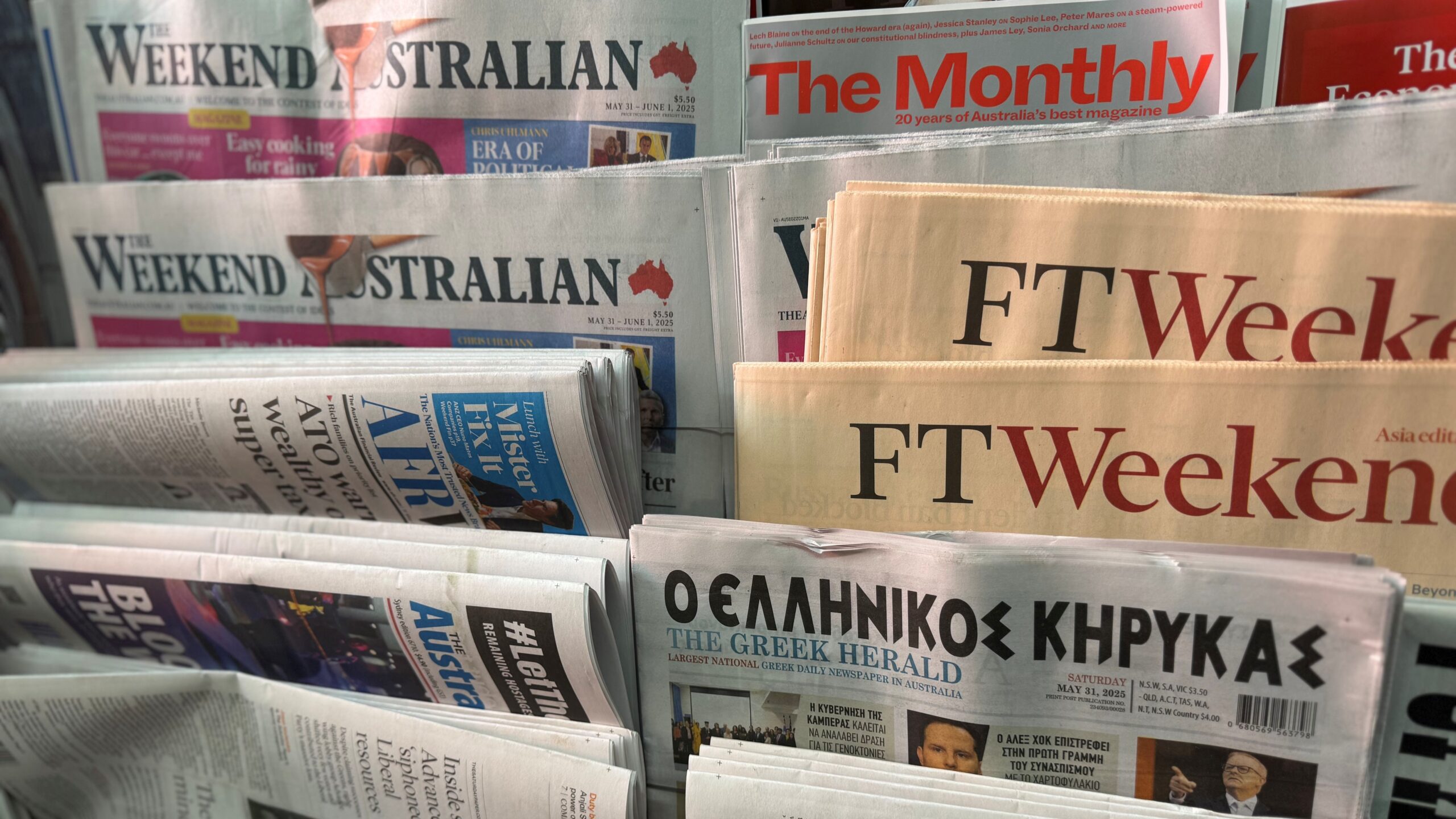
As Australia marks more than half a century of official multiculturalism, the role of ethnic media has never been more important — nor more contested.
In an age dominated by algorithms, misinformation, shrinking attention spans and collapsing trust in institutions, multicultural media outlets such as The Greek Herald continue to occupy a unique and increasingly vital position within Australian society.
For many communities, they remain more than simply news organisations. They are cultural anchors, historical archives, trusted translators, advocates and civic institutions rolled into one.
This year, The Greek Herald marks 100 years of continuous publication — a milestone that not only reflects the endurance of one newspaper, but also the broader story of ethnic media in Australia and its ongoing relevance in shaping the nation’s multicultural identity.
For Dr Bulent (Hass) Dellal AO, Executive Director of the Australian Multicultural Foundation, former Chair of SBS Television and Radio, and board member of Independent Multicultural Media Australia (IMMA), multicultural media remains essential to Australia’s social fabric.
“Multicultural and ethnic media play an essential role in helping Australians feel connected, informed and included,” Dr Dellal says. “They do far more than report the news; they build trust, preserve language and culture, and help communities navigate Australian society while also helping Australia better understand its own diversity.”
Dr Dellal recently chaired the Commonwealth Government’s Multicultural Framework Review, a landmark national process examining the future of multiculturalism in Australia. One of its strongest recommendations was improved support and recognition for multicultural media as essential democratic infrastructure.
The Review also acknowledged the advocacy work of IMMA, a national alliance representing independent multicultural publishers and broadcasters across the country, including The Greek Herald. The organisation has become an increasingly important voice in pushing for equitable government engagement, sustainable funding models and recognition of multicultural media as essential public-interest infrastructure.
“During the Multicultural Framework Review, one of the clearest messages we heard was that belonging matters,” Dr Dellal says. “Multicultural media help create a sense of belonging and serve as trusted bridges between cultures, generations, and communities, particularly during times of uncertainty or social tension.”
That role has become increasingly significant in a fragmented digital environment where communities are constantly exposed to unverified information online.
“In a media environment increasingly shaped by algorithms, misinformation and declining trust, independent multicultural journalism is more important than ever,” Dr Dellal says. “These outlets provide trusted, community-based communication grounded in language, lived experience and cultural understanding.”
He points to the COVID-19 pandemic as a defining example of the sector’s value.
“We saw this clearly during COVID-19, when multicultural media became a critical source of accurate information for many communities,” he says. “Just as importantly, they allow communities to tell their own stories in their own voices, rather than being defined by stereotypes or moments of crisis.”
Australia’s multicultural landscape has transformed dramatically over the last century. According to the Australian Bureau of Statistics, nearly one-third of Australians are now born overseas, while almost half have at least one parent born overseas. Yet despite that diversity, media representation remains uneven, with studies showing mainstream Australian media continues to be overwhelmingly Anglocentric.
Alongside public broadcasters such as SBS, independent publishers and organisations like IMMA have increasingly argued that community-based ethnic media fills gaps that broader national outlets often cannot — particularly when it comes to culturally specific reporting, local advocacy and community trust.
For Dr Stepan Kerkyasharian AO, one of Australia’s most influential multicultural leaders and a pioneer of SBS Radio, ethnic media plays a critical role in safeguarding both social cohesion and democratic integrity.
“Ethnic media whether in print, broadcast, televised, webcast or streamed is essential to provide a legitimate, reliable and impartial communication channel to counter the misinformation and often irresponsible circulation of false or misleading information,” Dr Kerkyasharian says.
He argues that, unlike the often chaotic and polarising nature of social media, professional ethnic media organisations remain grounded in traditional journalistic principles.
“What we call the Australia Ethnic Media, adheres to the fundamental principles of journalism, presenting unbiassed facts and information which reflects the diversity of views regarding any issue,” he says.
For migrant communities navigating both Australian life and international developments connected to their countries of origin, that balance is especially important.
“Social media constantly presents them with information, sometimes biased, and even if I may say so – provocative information,” Dr Kerkyasharian says. “A robust, impartial, professional ethnic media in Australia provides a vital counterbalance to that aspect of information dissemination.”
“In other words, Australian ethnic media is vital for the promotion of community harmony in multicultural, multifaith Australia.”
Yet the importance of ethnic media extends beyond present-day reporting. It also serves as an irreplaceable historical record of migrant Australia itself.
For much of the 20th century, mainstream Australian media paid little attention to the daily lives, struggles and achievements of non-English-speaking communities. In many cases, ethnic newspapers became the only institutions documenting those experiences.
Dr Kerkyasharian describes these archives as “a treasure chest for any historian.”
“Non-English language newspapers and magazines printed in Australia from those early days are the only true historical records which reflect the hopes, visions, and expectations of hundreds of thousands of migrants who came to Australia to start a new life in a hospitable land,” he says.
That observation is particularly relevant for The Greek Herald, whose pages over the last century have chronicled everything from migration waves and war service to church disputes, sporting triumphs, political struggles, language preservation and intergenerational change.
For Dr Dellal, such institutions form part of Australia’s national story itself.
“A publication like The Greek Herald is much more than a newspaper; it is part of Australia’s social history,” he says. “For 100 years, it has documented migration journeys, community life, language, culture, achievements and challenges that may otherwise have been overlooked or forgotten.”
“That legacy matters not only to Greek Australians but to Australia as a whole,” he adds. “It reminds us that multiculturalism was built not only through policy but also through communities creating institutions, organisations and services that sustained identity, participation, and connection across generations.”
Still, survival in the digital era will require adaptation.
Dr Kerkyasharian believes ethnic media must evolve beyond its traditional role of simply relaying homeland news.
“Ethnic media must utilise that multiplicity of channels to inform its followers all along, adhering to the principles of factual, accurate, impartial reporting,” he says.
He also argues the sector must increasingly embrace investigative journalism, analysis and deeper civic engagement.
“They must emulate mainstream English media, analyse events, comment on significant social, economic and political issues,” he says. “Provide a forum for members of their community to express their views on such matters and facilitate debate where appropriate.”
That push for stronger recognition and sustainability has become central to IMMA’s advocacy work nationally, particularly as many independent multicultural outlets face mounting financial pressure despite serving critical democratic and social functions.
Dr Dellal agrees that meaningful structural support will be critical if multicultural media is to remain sustainable for future generations.
“The Multicultural Framework Review recognised multicultural media as essential democratic and social infrastructure,” he says. “To remain sustainable, the sector needs more stable long-term funding, stronger inclusion in government communications and support to adapt to changing digital platforms and audiences.”
“Most importantly,” he concludes, “we need to recognise that multicultural media are not simply niche outlets. They strengthen trust, participation and social cohesion across Australian society.”
