For a century, sport has occupied a special place in the pages of The Greek Herald. It has never simply been about scores, trophies or results. Within the Greek Australian experience, sport became identity, visibility, pride and belonging. From the earliest decades of migration through to modern international competition, The Greek Herald documented not only the athletic achievements of Greeks around the world, but also the emotional heartbeat of a diaspora that saw itself reflected on sporting fields, courts, stadiums and Olympic podiums.
As early as the 1920s, the newspaper was already recording the sporting passions of Australia’s fledgling Greek communities. In an era when migration was difficult, racism was overt, and organised Greek institutions were still in their infancy, sport offered connection and recognition.
The paper’s editions from 1927 and 1928 reveal wrestling as one of the most popular forms of entertainment among Greek migrants, with packed crowds attending matches in Sydney and Melbourne to watch famous Greek wrestlers including Loukas Pergantas, Ioannis Kylonis and later the legendary Jim Londos. One report noted crowds of 15,000 attending wrestling contests, while another recorded Londos attracting an astonishing 50,000 spectators in 1929.
For migrant communities searching for belonging in a new country, these contests carried meaning far beyond the arena itself. The newspaper also documented the racism faced by Greek athletes and spectators at the time, reporting hostile mainstream attitudes and discriminatory treatment directed at Greek competitors and supporters.
Over time, The Greek Herald’s sporting coverage evolved alongside the community itself. As Greek Australians became more established, sport became deeply intertwined with communal identity. Across the decades, the paper documented the emergence of Greek athletic associations, youth organisations and sporting clubs that became cultural anchors for generations of migrants and their children.
One of the earliest and most historically significant references appears in January 1952, when The Greek Herald documented the establishment of the Athletic Association “Apollon,” described as a sporting entity with a “Pan-Hellenic audience.” The wording itself reflected how sport was understood within diaspora Australia – not merely athletic competition, but a broader expression of Hellenic identity, pride and unity.
Earlier still, the newspaper had recorded the establishment of the Macedonian Brotherhood Megas Alexandros in Perth in 1931, reflecting the symbolic importance of Hellenic history and identity within organised Greek communal life.
Those names and ideals would echo through the decades that followed as Greek Australians built football clubs that became synonymous with migrant identity and pride. Clubs such as Sydney Olympic FC, founded in 1957 as Pan-Hellenic, and South Melbourne FC, established in 1959 as South Melbourne Hellas, would eventually become giants of Australian football and central pillars of Greek Australian life.
Its pages chronicled the rise of ethnic football culture in Australia, the emergence of the National Soccer League in 1977, fierce rivalries, championship triumphs and the passion surrounding Greek-backed clubs across the country. Football grounds became gathering places for generations of Greeks, where chants, flags, smoke and rivalries preserved language, heritage and community identity.
Over time, the newspaper also documented the rise of other major Greek Australian football institutions including Heidelberg United, Collingwood Warriors and clubs associated with the enduring “Megas Alexandros” identity within diaspora sporting culture. During the National Soccer League era, these clubs became cultural homes for generations of migrants and their children.
At the same time, readers remained passionately connected to clubs in Greece itself, including Olympiacos F.C., Panathinaikos F.C., AEK Athens F.C. and PAOK FC, whose triumphs and derby clashes were followed closely in Greek cafes, homes and community clubs across Australia. For many first-generation migrants, following football from Greece maintained a living connection to homeland, memory and identity.
Throughout the decades, reporters and photographers from The Greek Herald became a familiar sight on sidelines, courts and sporting venues around Australia. You could see them running up and down football fields, standing behind goalposts with cameras, or interviewing young athletes after matches in suburban parks and community stadiums. The newspaper helped shine a spotlight on junior teams, local competitions and young Greek Australian athletes long before many became household names.
Numerous writers and editors attended Olympic Games, Australian Opens, international football tournaments and major diaspora sporting events, often travelling extensively to bring stories back to readers. The Greek Herald conducted interviews with emerging sporting talents during the early stages of their careers, many of whom later blossomed into internationally recognised athletes.
Sport was never treated as secondary coverage within The Greek Herald. Across generations, the newspaper maintained dedicated sporting editors, reporters and overseas correspondents who shaped sports journalism within Australia’s Greek media landscape.
Among the paper’s earliest sporting editors were Ioannis Paradeissis, who served between 1934 and 1939, and Nikolaos Politis during the post-war years from 1949 to 1951. They were followed by respected figures including Athanasios Hatzianestis, appointed sporting editor in 1971 and described within the archive as “a most prominent journalist,” alongside Kostas Nikolopoulos and longtime journalist Michalis Mystakidis, who joined The Greek Herald as sporting editor in August 1978 before later becoming Chief Editor. Through his widely read column “Metakxi Mas” (“Among Us”), Mystakidis connected readers not only to matches and results, but to the personalities, debates and communal spirit surrounding Greek and Greek Australian sport for decades.
The newspaper also maintained direct sporting links with Greece itself. During the late 1960s, sporting correspondent P. Tsirigotakis of ERT transmitted reports and detailed analysis of Greek league football directly to the newspaper, while Byron Levantis and Georgios Karkanidas provided ongoing coverage of football across Greece, Europe and Australia. Sporting correspondents including M. Koutelas in Adelaide, B. Mantinaos in Canberra and Nikos Kitsakis in Melbourne ensured Greek communities nationwide remained connected through sport.
The Olympic Games always held profound symbolic importance for the newspaper and its readership. Greece, as the birthplace of the Olympics, occupied a unique place in the sporting imagination of the diaspora.
When the 1956 Summer Olympics opened on 22 November 1956, it marked the first Olympic Games held in the Southern Hemisphere and became a milestone moment for Greek Australians. Coverage followed Greece’s participation closely, including the bronze medal won by Greek pole vaulter Georgios Roubanis on 27 November 1956.
One particularly remarkable moment recorded in the pages of The Greek Herald during the Melbourne Olympics involved Greek Australian athlete Constantinos Verevis of Cairns, who became the first runner to carry the Olympic Flame on Australian soil on 25 October 1956. The archive noted that the twenty-two-year-old Greek Australian carried the torch from the airport into Cairns during the historic relay, creating a lasting symbolic connection between Australia’s Greek community and the Olympic movement itself.
The newspaper also documented the arrival of television in Australia just days before the Melbourne Olympic Games, recognising the enormous transformation this would bring to sporting coverage and public life. For The Greek Herald, televised sport marked the beginning of a new media era that would reshape how migrant communities experienced international competition from afar.
The 2000 Summer Olympics marked another defining chapter in The Greek Herald’s sporting coverage. From the opening ceremony on 15 September 2000 through to the closing celebrations on 1 October, the newspaper followed the Games extensively as Sydney became the centre of the sporting world.
For Greek Australians, the Sydney Olympics carried particular emotional significance. It represented the Olympic movement returning symbolically to a city shaped by generations of migrants, including thousands of Greeks who had helped build modern multicultural Australia.
Reporters and photographers from The Greek Herald covered events across Olympic venues, documenting not only Greece’s participation but also the overwhelming involvement of the Greek Australian community throughout the Games. The newspaper followed the triumphs of Australian athletes with equal pride, including iconic gold medal victories by athletes such as Cathy Freeman, whose historic 400m win on 25 September 2000 became one of the defining moments in Australian sporting history.
Its pages also celebrated Greek Olympic success, including the gold medal victory of legendary weightlifter Pyrros Dimas on 17 September 2000. Dimas, already a hero throughout the Greek world, became a symbol of resilience, pride and determination for Greeks everywhere.
Decades later, the newspaper again captured history when Athens was awarded the 2004 Olympic Games on 5 September 1997. For Greeks across the world, the decision represented the symbolic return of the Games to their spiritual homeland.
When the 2004 Summer Olympics officially opened on 13 August 2004, Greek Australians celebrated with enormous emotion. Many travelled to Greece to witness the Games firsthand, while countless others gathered in homes, clubs and cafes across Australia to watch the opening ceremony.
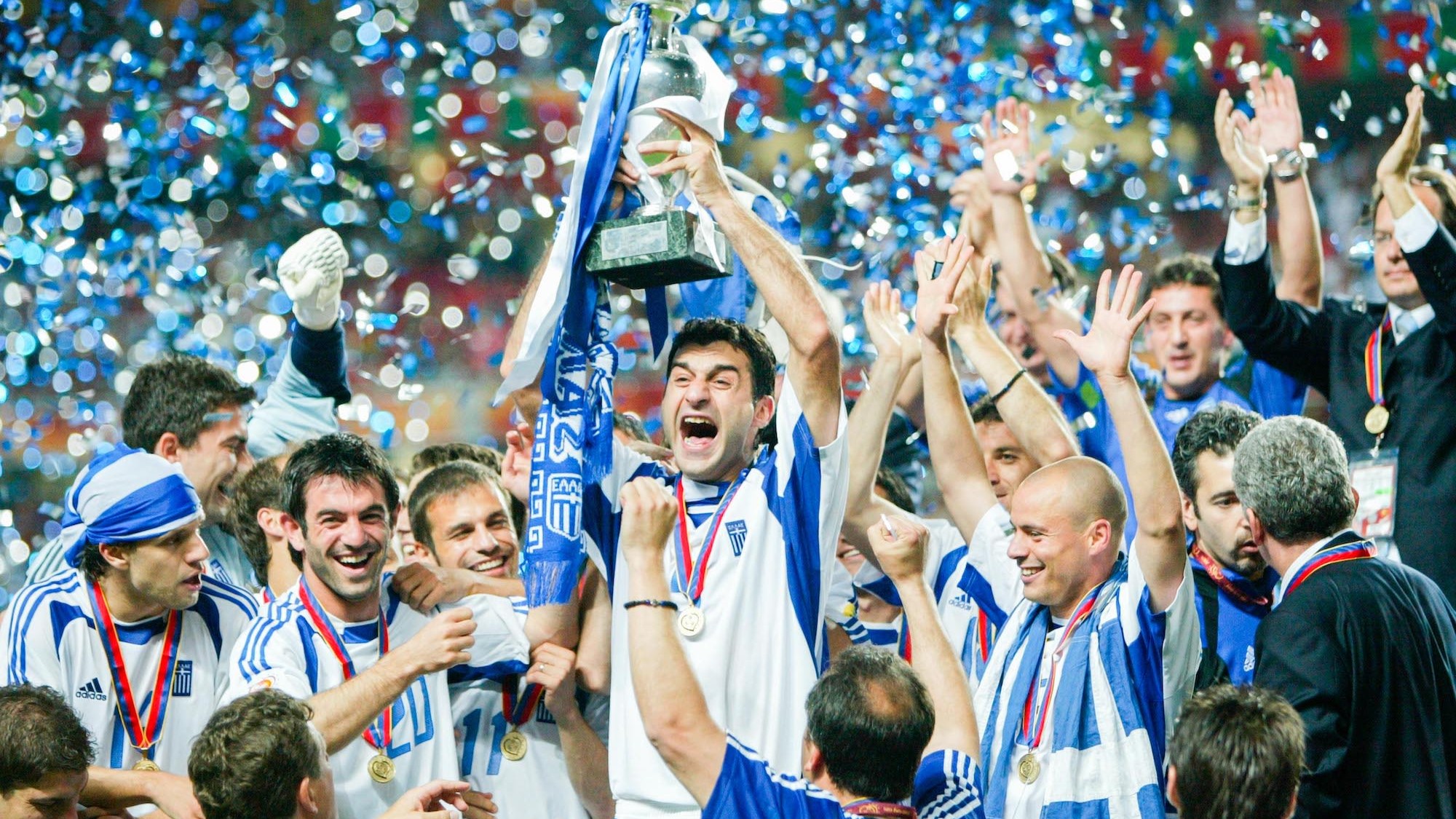
Only weeks earlier, however, another sporting miracle had already united Greeks worldwide in scenes that remain unforgettable.
On 4 July 2004, Greece defeated Portugal 1-0 to win UEFA Euro 2004 in one of the greatest underdog victories in football history.
In the lead-up to Greece’s historic Euro 2004 triumph, The Greek Herald also promoted free public live screenings with Sydney’s Enmore Theatre, inviting supporters to gather from as early as 3am to watch Greece’s matches on giant cinema screens alongside hundreds of fellow Greek Australians in a shared atmosphere of anticipation, pride and celebration.
The Greek Herald was there as the celebrations erupted.
Across Sydney, particularly in areas such as Enmore, Marrickville and Brighton-Le-Sands, cafes and community venues overflowed with supporters watching giant screens and televisions broadcasting the match live from Portugal. As the final whistle blew, the streets transformed into seas of blue and white. Cars flooded the roads with Greek flags waving from windows. Young people climbed onto rooftops and balconies chanting “Ελλάς! Ελλάς!” Strangers embraced one another in tears and disbelief.
Reporters from The Greek Herald moved through packed streets documenting scenes of jubilation as thousands of Greek Australians celebrated together deep into the night. Drums echoed through suburban streets. Flares illuminated intersections. Entire families emerged from homes and businesses to celebrate side by side. For many first-generation migrants who had endured hardship, displacement and years of struggle, Greece’s triumph represented something deeply emotional and symbolic.
Coverage also followed Greece’s rise in basketball during the 1980s, particularly the national team’s historic victory at EuroBasket 1987 on 14 June 1987, led by Nikos Galis. That triumph transformed basketball into a national obsession in Greece and resonated strongly throughout the diaspora.
The newspaper also maintained strong coverage of aquatic sports, particularly water polo, a discipline in which Greece emerged as an international powerhouse. The achievements of the Greek national teams became a consistent source of pride throughout the diaspora, culminating in Greece’s silver medal at the 2020 Summer Olympics men’s water polo tournament final on 8 August 2021.
Over the decades, The Greek Herald’s journalists became regular figures at the Australian Open, interviewing players, attending press conferences and documenting the rise of Greek tennis stars on the international stage. Coverage intensified with the emergence of Stefanos Tsitsipas, whose deep runs at Melbourne Park drew enormous support from Greek Australians who filled stadiums waving blue and white flags.
The pages of The Greek Herald later chronicled the extraordinary achievements of Greek sporting icons including Pyrros Dimas and Giannis Antetokounmpo, whose remarkable journey from poverty in Athens to NBA champion and Most Valuable Player inspired younger generations throughout the diaspora.
Today, The Greek Herald Sport Section continues that tradition across both print and digital platforms, covering a broad mix of sporting content through a strong Hellenic and community lens rather than purely mainstream match reporting.
Coverage continues to focus heavily on Greek Australian football culture, particularly clubs such as Sydney Olympic FC, South Melbourne FC and Bentleigh Greens SC, alongside broader National Premier Leagues and community football coverage. Reporting extends beyond results to governance issues, milestones, supporter culture, player signings, club anniversaries and the evolving role of Greek heritage clubs within Australian football.
The newspaper also continues to follow the Greek national football team and Greece’s major clubs, while profiling Greek Australian athletes across football, basketball, tennis, athletics, swimming and combat sports. Junior tournaments, school sport, youth academies and community fundraising events remain central to coverage, reflecting the newspaper’s longstanding commitment to spotlighting young talent and giving smaller clubs visibility.
Historical retrospectives, migrant sporting stories, old photographs, club founders and nostalgia pieces continue to serve as an important cultural archive of the Greek Australian experience.
Among the key names associated with modern sports coverage is longtime sports editor Peter Triandafillou, also known as Takis, who commenced with the Herald in October 2009. He is recognised particularly for his football writing, historical features, player profiles and extensive coverage of Greek Australian soccer culture, including interviews with emerging young players and figures connected to the National Soccer League era.
Another longstanding contributor is Bill (Vasilis) Roumeliotis, who has contributed to community sporting coverage since 2007, particularly within the Sydney Greek football landscape and grassroots competitions.
The Greek Herald’s involvement in sport has also extended far beyond reporting. Across decades, the newspaper has acted as media sponsor, supporter and promotional partner for numerous sporting clubs, tournaments and community events.
One of the most significant modern examples came in 2025 through the newspaper’s involvement with the Pavlos Giannakopoulos Tournament in Australia, which brought international basketball attention to Sydney and connected Greek sporting culture with the Australian NBL landscape. The tournament featured Serbian powerhouse KK Partizan against the Sydney Kings in a spirited and entertaining clash that further demonstrated the strong appetite for international Hellenic-linked sporting events within Australia.
Yet perhaps no modern sporting initiative reflects the relationship between The Greek Herald and Greek Australian sport more profoundly than the creation of the Greek Herald Cup itself.
The inaugural Greek Herald Cup was held on 13 January 2024 at Jubilee Stadium in Sydney before close to 3,000 supporters, shortly after both Sydney Olympic FC and South Melbourne FC had been confirmed as foundation clubs in Football Australia’s proposed National Second Tier competition.
Importantly, the event carried the name of The Greek Herald itself, recognising the newspaper’s decades-long role as a central platform for coverage, announcements and support of both clubs throughout their histories.
The occasion became a celebration of Greek Australian sporting culture, featuring live music, Greek dancing, junior football and generations of supporters reconnecting through football nostalgia and shared identity.
The success of the inaugural event led to a second edition of the Greek Herald Cup on 18 January 2025 at Lakeside Stadium in Melbourne, where supporters again gathered for what had now become an annual Hellenic football spectacle. South Melbourne FC won the 2025 edition 2-1, but the broader significance again extended far beyond the result itself.
Then came the defining historical twist.
On 10 October 2025, the very same two clubs – South Melbourne and Sydney Olympic – officially opened the inaugural Australian Championship at Lakeside Stadium, launching Australia’s long-awaited national second-tier football competition.
In retrospect, the Greek Herald Cup fixtures of 2024 and 2025 became symbolic curtain-raisers for the rebirth of national community football in Australia.
For one hundred years, sport in The Greek Herald has reflected far more than competition. It has documented migration, aspiration, youth achievement and the evolving identity of Hellenism in Australia.
From the wrestling halls of the 1920s to Olympic stadiums, football terraces, basketball arenas and suburban sporting grounds, the newspaper has stood beside generations of athletes, supporters, volunteers and young dreamers – preserving not only the results, but the spirit of a community that found pride, belonging and visibility through sport.
