For decades, the rhythm of The Greek Herald was mechanical.
Printing presses thundered through the night. Pages were assembled by hand with scissors, glue and film. Journalists raced against strict deadlines while printers worked under enormous pressure to ensure newspapers reached Greek homes across Australia by morning.
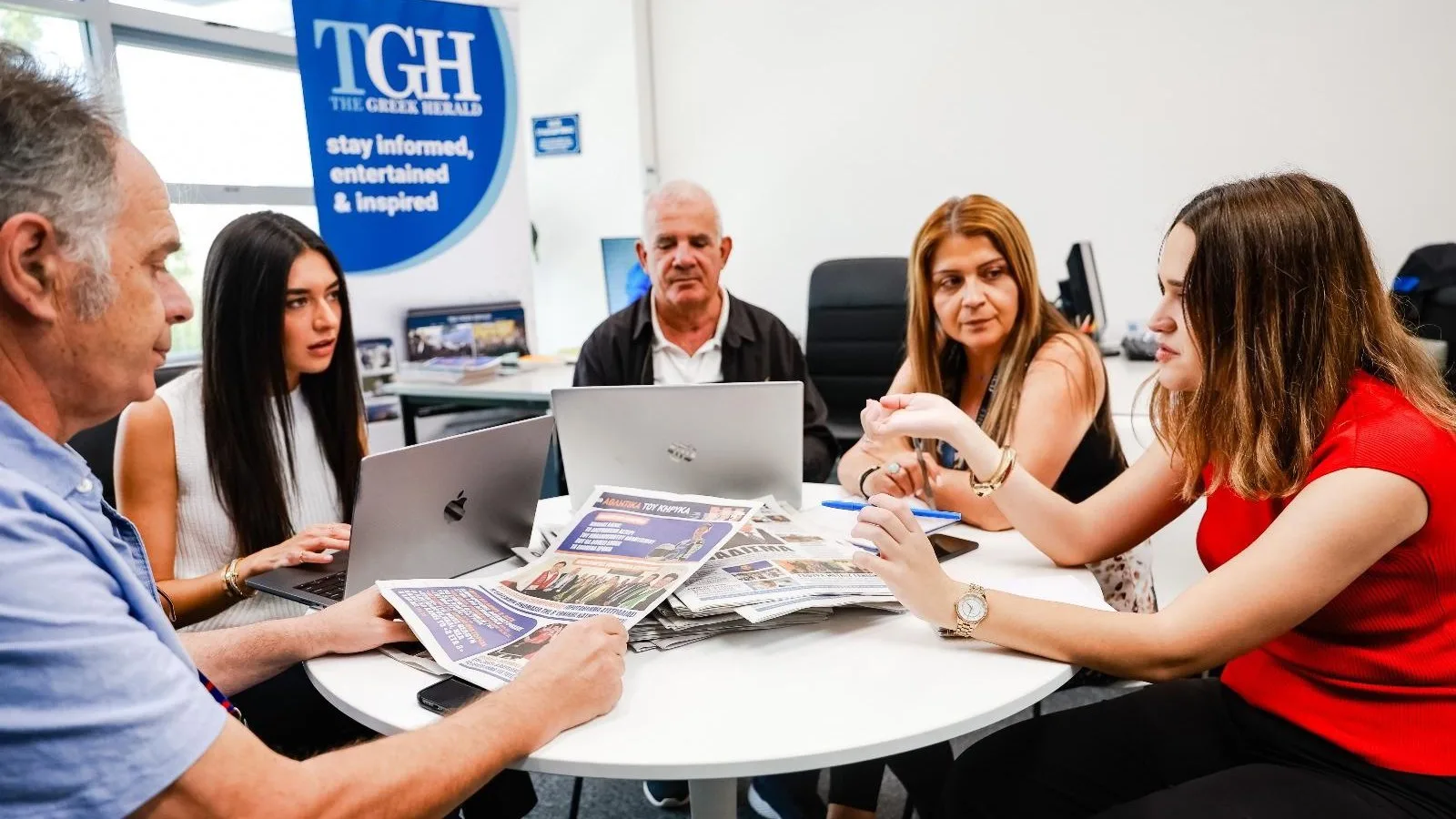
Today, the newsroom looks very different.
Stories are uploaded instantly. Breaking news travels across mobile phones within seconds. Social media, video journalism and digital publishing now sit beside the physical newspaper that generations of Greek Australians once waited for at the local newsagent.
Yet despite the transformation from print to pixel, one thing has remained remarkably constant: The Greek Herald’s role as a bridge between generations of Greek Australians.
As the newspaper enters its centenary year, its evolution reflects not only the transformation of media itself, but also the changing identity of Greek Australia.
For much of the 20th century, the newspaper was entirely physical. Every stage of production was manual and labour intensive. Pages were carefully laid out by hand, photographs physically positioned, headlines cut and assembled, and entire editions sent through large industrial printing presses before distribution across Australia.
Inside the newsroom, there was no room for error. Long nights, pressure before deadlines and the constant movement between editorial, production and printing departments defined the newspaper’s daily life.
Over time, however, technology slowly transformed every corner of the operation.
Computers replaced manual layout processes. Digital typesetting replaced older production methods. Printing systems became increasingly automated. Eventually, the internet would reshape not only how newspapers were produced, but how audiences consumed news itself.
By the late 2010s and early 2020s, The Greek Herald had entered one of the most transformative periods in its history, evolving into a bilingual multimedia newsroom while continuing its historic Greek-language print edition.
“The way audiences consume news today is completely different to even a decade ago,” says The Greek Herald Digital Editor Andriana Simos.
“Readers expect immediacy now. They are consuming news through phones, video, social media and multiple digital platforms simultaneously. Community media has had to adapt to that reality while still preserving the trust and identity that made these institutions important in the first place.”
The shift into digital publishing accelerated rapidly during the COVID-19 pandemic, when audiences increasingly relied on online platforms for immediate updates surrounding lockdowns, border closures and public health announcements.
For multicultural media organisations, the transition became about far more than simply keeping pace with technology.
It became about survival.
Across Australia, many ethnic publications either downsized or disappeared entirely as print advertising declined and digital platforms reshaped the media industry. Yet The Greek Herald continued expanding its online presence while still maintaining the physical newspaper that had existed for generations.
“There is still something incredibly emotional and tangible about print, particularly within migrant communities,” Ms Simos says.
“For many readers, the newspaper is part of their weekly routine and identity. People keep editions, cut out stories, save photographs and archive important family or community moments. Print still carries a sense of permanence that digital platforms often cannot replicate.”
That balance between preserving tradition and embracing innovation has increasingly shaped the newspaper’s modern identity.
Alongside digital expansion, The Greek Herald has continued investing in initiatives designed to keep younger generations connected not only to Greek Australian media, but to print culture itself.
Among them are the newspaper’s annual Christmas cover competitions, which invite children and young people to design front covers for special festive editions.
“It is important that younger generations still feel connected to print, even while growing up in a digital-first environment,” Ms Simos says.
“The cover competitions are about creating that connection early. They allow younger Greek Australians to see themselves reflected in the newspaper while also understanding that community media belongs to them too.”
At the same time, the newsroom itself continues evolving.
Video journalism, live coverage, social-first reporting and multimedia storytelling have become increasingly central to how The Greek Herald reaches audiences across Australia and internationally.
The newspaper’s digital platform now publishes daily news coverage spanning community affairs, politics, church, education, sport, culture, migration, investigations and major developments affecting the Greek diaspora both in Australia and abroad.
Breaking news coverage has become faster and more immediate than ever before, while digital publishing has also allowed The Greek Herald to cover significantly more community events, stories and local initiatives across multiple Australian states than would once have been possible through print alone.
“Digital media has allowed us to tell more stories from more parts of the community in real time,” Ms Simos says.
“We are now able to cover events as they happen, reach audiences nationally and internationally instantly, and give visibility to community stories that may once have had far more limited reach through traditional print cycles.”
Social media and online publishing have also expanded the newspaper’s connection with younger audiences and the wider Greek diaspora internationally, allowing stories from Australian Hellenism to travel far beyond the local community itself.
But even as technology changes, the broader mission remains remarkably similar to the one first imagined almost 100 years ago.
To connect communities.
To preserve language and culture.
To document the lives, stories and identity of Greek Australians across generations.
The presses may no longer define the newsroom the way they once did.
But they still run.
And now, the stories travel far beyond the printed page.
