For Sophia Anastasiades, The Greek Herald was never simply a newspaper. It was part of her family history, community identity and the evolving story of Greek Australia itself.
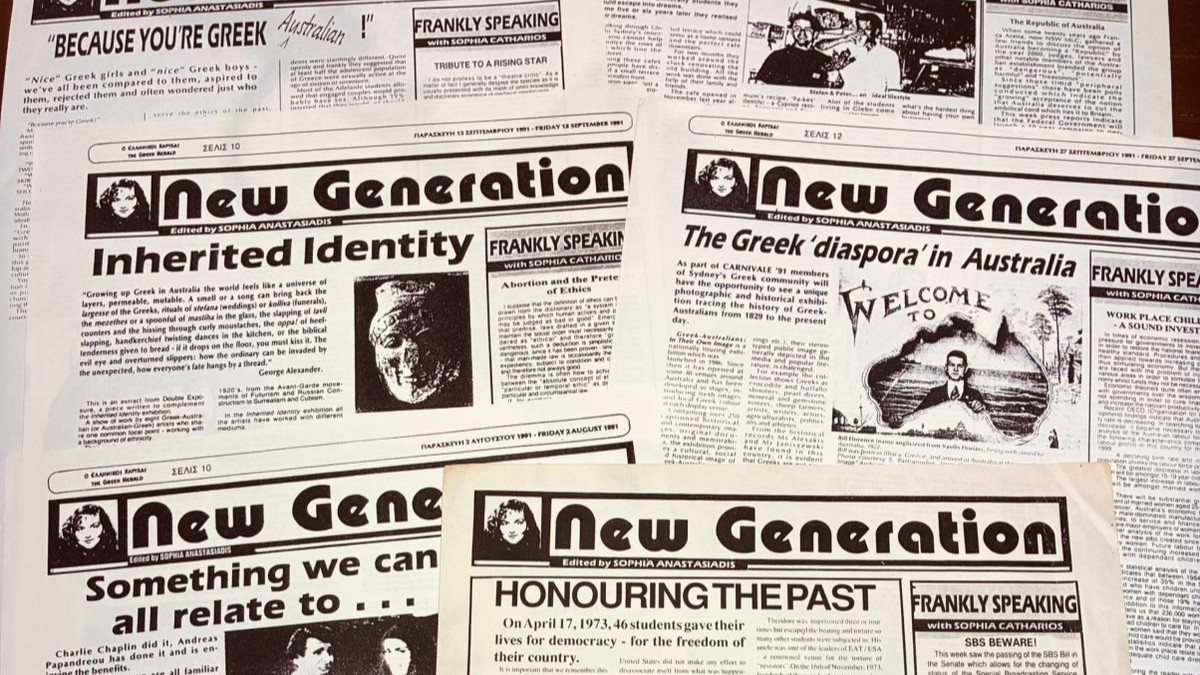
More than three decades ago, Ms Anastasiades became one of the key figures behind a major shift within the publication — the introduction of “New Generation,” an English-language page dedicated to young Greek Australians navigating life between cultures.
“Thirty-five years ago, the late Theo Skalkos invited me to take on the task of starting ‘New Generation’, an English-language page in The Greek Herald,” Ms Anastasiades says.
“He was a visionary and he believed I could do it.”
At the time, she was studying Communications at the University of Technology Sydney while also undertaking journalism training at News Ltd.
“He knew I was in the middle of my Communications Degree at UTS and had Print Journalism training at News Ltd, as a ‘foot-in-the-door’ Copy Person; the hard yards of early starts and the ‘rounds’ of the papers,” she says.
“It was only after the Murdoch Press initiation that Theo thought I could take on the mission.”
Partnering with respected writer and SBS figure Sophia Catharios, Ms Anastasiades helped launch one of the first sustained English-language youth platforms within a traditionally Greek-language newspaper.
“Professionally it was an incredible opportunity, I gained valuable experience and some great mentors,” she says.
“Personally, it was eye-opening. I had no idea our community had such an array of creative, passionate and inspired youth.”
At a time when Greek remained dominant throughout the newspaper, “New Generation” deliberately focused on second-generation Greek Australians.
“This page was for the Next Generation, the spotlight was on young Greek Australians; their passions, their perspective, their voice and how they connected with their heritage,” she says.
The response was immediate.
“It successfully attracted a new audience,” Ms Anastasiades says.
“It was clear there was a gap in the news. Younger readers were now picking up the papers and reading stories in English; the familiar newspaper they had seen their parents buying for years.”
The section quickly became a platform for young artists, writers, theatre groups and university Greek clubs searching for visibility within the community.
“The ‘younger demographic’ began reaching out and contacting me directly,” she says.
“Suddenly theatre groups, artists, designers, poets, writers & University Greek clubs, had a place to share their stories, their news, accomplishments and all the things they were working so hard for.”
For Ms Anastasiades, publishing stories in English never felt like abandoning Greek identity. Instead, it created a bridge between generations inside a rapidly changing diaspora community.
“The youth could now read about what was happening amongst them, as well as share their experiences and their news,” she says.
At the same time, she says older generations began seeing younger Greek Australians differently.
“It was clear that the younger Greeks were interested in coming together and preserving the Greek identity, representing the Greek spirit in their own unique way, through culture, art, theatre and professional networking,” Ms Anastasiades says.
The early 1990s represented a particularly complex period for second-generation Greek Australians balancing traditional family expectations with multicultural Australian life.
“The first generation of Australian-born Greeks found themselves caught between cultures,” Ms Anastasiades says.
“Their parents remained deeply entrenched in traditional Greek values, maintaining strict morals, which often clashed with the independence the next generation were seeking.”
Much of the writing within “New Generation” reflected those tensions directly, including a controversial series titled Greek Women on Love, Sex, and Marriage.
“In the two-part series, ‘Greek Women on Love, Sex, and Marriage,’ a group of female university students shared their perspectives on being ‘Good Greek Girls’, the pressure of patriarchal expectations, grandiose weddings, and the conflicts of living between two cultures,” she says.
“Some of the content, considered taboo, such as pre-marital sex, sparked some friction and backlash within the community, which proved to be a confronting experience for a young journalist!”
Looking back, Ms Anastasiades believes the English-language pages helped reshape The Greek Herald from a migrant newspaper into a broader diaspora publication.
“Publishing stories in English shifted both the audience and the purpose of the paper,” she says.
“The English section reached a younger generation who may not have been fluent in their parents’ native language, allowing the publication to move beyond stereotypical notions of the Greek Australian experience.”
For Ms Anastasiades, the connection to The Greek Herald is also deeply personal and spans generations.
“The Greek Herald has been a cornerstone of the Greek community for a century and it has played a significant role in my family’s history, over the course of my whole life,” she says.
Her late father, John Anastasiadis, joined the newspaper as Advertising Manager during the mid-1960s, while her mother, Anastasia Anastasiadis, later contributed historical, cultural, theological and educational articles after completing a Master’s Degree in Modern Greek Literature.
Today, Ms Anastasiades sees the newspaper’s bilingual evolution as central to its enduring relevance.
“The Greek Herald has evolved into a bilingual digital platform sharing news in both Greek and English,” she says.
“It continues to be an important point of contact for me within the Greek community and serves as a ‘Hellenistic anchor’ in my life, here in Australia.”
