By the late 1990s, Greek Australia had entered a fundamentally different era from the migrant world that had shaped the newspaper’s earlier decades.
The postwar generation had now firmly established itself within Australian public life. Greek Australians had become parliamentarians, academics, lawyers, journalists, business leaders and institutional figures, while Greek community organisations across the country had evolved into increasingly sophisticated and influential institutions.
Communications technology was rapidly transforming the relationship between diaspora communities and their homelands.
Satellite broadcasting, international travel and emerging digital communications allowed developments in Greece to reach Australia faster than ever before, fundamentally reshaping the emotional and cultural relationship between expatriate Hellenism and the Greek centre.
The years between 1997 and 2006 captured that transformation.
This was the decade in which the Herald evolved from a traditional migrant newspaper into a modern multimedia diaspora institution with growing international reach, direct political and media relationships in Greece, and increasing recognition throughout the global Hellenic world.
The period was defined by the rise of satellite broadcasting, the institutionalisation of the global diaspora through SAE, the Sydney and Athens Olympic eras, expanding Greek Australian political influence, major educational and cultural initiatives, and the increasing confidence of organised Hellenism throughout Australia.
At the centre of many of those developments stood The Greek Herald itself.
Under the leadership of Theo Skalkos, the newspaper expanded operationally, technologically and institutionally during a period of rapid change in both journalism and diaspora life. The paper increasingly positioned itself not merely as an observer of Greek Australian history, but as an active participant helping connect Australia with Greece, Cyprus and the wider Hellenic world.
A new media era and the arrival of ANTENNA
One of the defining turning points of the decade came in July 1997, when ANTENNA TV commenced broadcasting in Australia from Sydney under an initiative involving Theo Skalkos and the Foreign Language Press group.
The development represented one of the most significant transformations in diaspora communication since the establishment of Greek radio broadcasting in Australia decades earlier.
For much of the twentieth century, diaspora Greeks relied on delayed newspapers, imported magazines, videotapes and occasional shortwave broadcasts to maintain connection with Greece. ANTENNA fundamentally changed that relationship by bringing Greek television, entertainment, political developments and cultural programming directly into Greek Australian homes.
The Greek Herald extensively documented the expansion of the service while also playing a direct role in facilitating and supporting its development in Australia.
In September 1998, The Greek Herald reported on direct collaboration between Theo Skalkos, ANTENNA founder Minos Kyriakou and senior ANTENNA executives.
Later that year, ANTENNA chief executive Ioannis Kalimeris travelled to Sydney to hold discussions with Skalkos and the Foreign Language Press group surrounding transmission agreements and the station’s expansion in Australia.
The relationship reflected the increasingly influential role The Greek Herald group had assumed within diaspora media.
In May 1997, Foreign Language Press also announced the relocation of its operations to new premises at 7 Garners Avenue, Marrickville, reflecting the continued operational expansion of the newspaper group during a period of rapid technological and institutional growth.
The newspaper itself was no longer simply a print publication reporting on Greek Australian life. It was increasingly operating as a multimedia institution.
Throughout the late 1990s and early 2000s, The Greek Herald group and ANTENNA jointly supported major cultural promotions, entertainment initiatives and community events, including beauty pageants and touring productions that reflected the growing sophistication and confidence of Greek Australian media during the period.
The global diaspora and the rise of SAE
What had emerged tentatively during the previous decade now evolved into a far more organised international diaspora structure.
Throughout the late 1990s, The Greek Herald extensively documented the activities of the World Council of Hellenes Abroad (SAE), which sought to formally organise and connect Greek communities throughout the world.
In December 1997, The Greek Herald closely followed the First Congress of SAE in Thessaloniki, where prominent diaspora leader Andrew Athens was elected the organisation’s first president, alongside Australian representatives including Kostas Vertzayias and Dimitris Konstantinidis.
The newspaper portrayed SAE as one of the most ambitious attempts ever undertaken to institutionally unite global Hellenism.
Senior figures including Stavros Lambrinidis, Grigoris Niotis, George Papandreou and Dimitris Dollis regularly appeared throughout the newspaper’s coverage as Greece intensified its engagement with expatriate communities.
Journalists including Michael Mystakidis attended and reported extensively on SAE congresses and world conferences, while The Greek Herald increasingly acted as one of the principal media platforms linking Australian Hellenism with emerging global diaspora structures.
In June 1997, the newspaper reported that expatriate Greeks would eventually be permitted to vote by mail, one of the defining long-term political demands of global Hellenism.
The Greek Herald repeatedly framed expatriate Greeks not as temporary migrants abroad, but as an integral part of a wider and permanent Hellenic world.
The decade also saw Australian Greek leaders assume increasingly important roles within global diaspora affairs.
In July 1999, Dimitris Dollis resigned from Australian politics before later becoming Secretary General for Greeks Abroad under George Papandreou, symbolising the increasingly transnational nature of Greek Australian political leadership.
The newspaper closely followed those developments and increasingly presented Greek Australia as one of the most organised and politically influential diaspora communities in the world.
The period also saw a growing emphasis on second-generation and youth leadership within organised Hellenism, as younger Greek Australians increasingly entered professional, political and institutional roles.
Sydney 2000, Athens 2004 and Olympic Hellenism
Few periods generated greater pride throughout Greek Australia than the Olympic era spanning Sydney 2000 and Athens 2004.
In September 1997, The Greek Herald celebrated Athens winning the right to host the 2004 Olympic Games, documenting the excitement generated throughout Greek Australia and the support expressed by Australian political leaders including Bob Carr.
Throughout the lead-up to Sydney 2000, The Greek Herald documented Olympic exhibitions, diplomatic events, sporting preparations and major Greek Australian celebrations connected to the Games.
Political leaders including Bob Carr, Jeff Kennett and former Prime Minister Gough Whitlam repeatedly expressed support for Greece’s historical connection to the Olympics and the reunification of the Parthenon Sculptures, positions that received extensive coverage throughout the newspaper.
The paper also highlighted major Olympic cultural initiatives including the exhibition ‘1000 Years of Olympic Spirit,’ officially opened by Bob Carr, who publicly praised Greece’s contribution to world civilisation.
The Sydney Olympics themselves became one of the defining emotional moments of the decade.
In September 2000, thousands gathered at Brighton-Le-Sands in Sydney for the unveiling of the statue of Greek Olympic champion Spyros Louis in the presence of Archbishop Stylianos and senior community leaders.
The Greek Herald extensively documented the event, presenting it as a powerful symbol of the historic connection between Greece and Australia.
The newspaper also followed the arrival of Greek Olympians in Australia, Olympic cultural exhibitions and broader Greek Australian participation in the Games.
The excitement surrounding Athens 2004 also extended into Australia through Olympic cultural celebrations and the torch relay, which generated enormous enthusiasm throughout Greek Australian communities.
The paper continued covering major transnational social issues affecting the diaspora, including the long-running pensions negotiations between Australia and Greece, with federal parliamentarian Andrew Theophanous repeatedly applying pressure on both governments to expedite an agreement for ageing migrants and pensioners.
For many within the diaspora, the Olympic period represented the peak of Greek cultural visibility within Australian public life.
The Greek Herald not only documented that period but helped preserve the visual and emotional archive of Greek Australia’s Olympic era.
In October 1997, The Greek Herald covered and participated in the Conference of Greek Journalists in Australia, reflecting the growing professionalisation and national coordination of Greek-language media throughout the country.
Education, language and the future of Hellenism
By the late 1990s, debates surrounding Greek language preservation had shifted from expansion to survival.
The Herald repeatedly argued that the long-term future of Hellenism in Australia depended on maintaining Greek language education among younger generations.
The newspaper extensively promoted educational conferences, university initiatives, cultural exhibitions and research institutions connected to Greek studies in Australia.
One of the most important developments involved the expansion of the National Centre for Hellenic Studies and Research (EKEME) at La Trobe University.
In June 1997, The Greek Herald documented the establishment of the Centre following a major donation by benefactor Jack Dardalis and the appointment of Dr Anastasios Tamis to a leading academic role within the institution.
Throughout the decade, the paper closely followed lectures and seminars involving internationally recognised scholars including George Babiniotis, Spyros Vryonis, Georgios Paxinos and Evangelos Konstantinou.
The newspaper itself became one of the principal platforms promoting educational and cultural initiatives connected to Hellenism in Australia.
In June 1998, The Herald discussed the long list of sponsors and benefactors who collectively contributed hundreds of thousands of dollars toward sustaining Modern Greek studies at Macquarie University.
The newspaper also closely followed the expansion of the National Centre for Hellenic Studies and Research (EKEME) at La Trobe University, documenting the pivotal $300,000 donation by benefactor Zissis Jack Dardalis, the support of Vice-Chancellor Prof. M. J. Osborne, the elevation of Dr Anastasios Tamis to Professor, and wider community fundraising efforts, including contributions from the Meligalas Association led by Takis Kyrkilis.
The paper consistently framed such campaigns not simply as educational matters, but as part of the broader struggle to preserve Greek identity among future generations.
In August 1997, The Greek Herald also published one of the first demographic warnings in the Greek Australian press about the rapid ageing of the community, foreshadowing many of the cultural and institutional challenges that would emerge in later decades.
Despite growing concerns surrounding assimilation, Greek language schools in major centres including Sydney and Melbourne continued attracting strong enrolments throughout much of the decade.
At the same time, warning signs surrounding language decline became increasingly evident.
The newspaper documented the collapse of Modern Greek departments at Australian universities, including the decline of the program at the University of New England, while repeatedly warning about assimilation and declining student numbers.
The contradiction reflected a defining tension of the era.
While Greek Australians had achieved enormous institutional and economic success, concerns surrounding cultural continuity became increasingly urgent.
The Greek Herald consistently positioned itself at the centre of that debate.
Political influence and mainstream integration
By the late 1990s, Greek Australians had become deeply embedded within Australian political life.
The Greek Herald extensively documented the rise of Greek Australian parliamentarians, ministers, councillors and political candidates across Australia.
In September 1998, the newspaper reported that twenty-five Greek Australian candidates would contest the federal election, including Petro Georgiou, Steve Georganas, Nick Bolkus and numerous others.
Figures including Theo Theophanous, Dimitri Dollis, Petro Georgiou, Steve Georganas and Nick Bolkus appeared regularly throughout the paper’s political coverage.
The newspaper also maintained increasingly direct relationships with political leaders in both Australia and Greece.
Those relationships were increasingly visible through regular visits by senior Australian political figures to the newspaper’s offices themselves. In 1998, Federal Immigration and Multicultural Affairs Minister Philip Ruddock visited Theo Skalkos and the newspaper group during discussions surrounding multicultural policy and the evolving role of ethnic media in Australia. The visit reflected the growing recognition of The Greek Herald not simply as a community newspaper, but as an influential institution within Australia’s multicultural media landscape.
Greek ministers, parliamentarians and diplomats regularly granted interviews to The Greek Herald and used the newspaper to communicate directly with the diaspora community.
Political figures including Evangelos Venizelos, Apostolos Kaklamanis, Anna Diamantopoulou, Stavros Lambrinidis and numerous others visited Australia throughout the period and received extensive coverage within the newspaper.
The paper increasingly functioned not simply as a newspaper covering political affairs, but as part of the broader communication infrastructure linking Greek Australia with political developments in Greece and Cyprus.
The decade also saw continued coverage of major international issues including Greco-Turkish tensions, Cyprus, Macedonia, European integration and the broader geopolitical role of Greece.
The Greek Herald increasingly presented Greek Australians not merely as migrants observing those developments from afar, but as politically engaged participants within global Hellenism.
Business confidence, culture and institutional growth
The decade also reflected the continued economic and institutional maturation of Greek Australia.
Greek financial institutions including Bank of Cyprus and Laiki Bank expanded operations throughout Australia during the late 1990s and early 2000s, reflecting the growing commercial sophistication of the diaspora community.
The Greek Herald closely followed investment forums, business conferences and expanding commercial links between Greece and Australia.
At the same time, major benefactors increasingly funded educational, welfare and cultural initiatives throughout the country.
Figures including Jack Dardalis, George Lianos and Tassos Tsapralidis regularly appeared throughout the newspaper’s coverage supporting universities, welfare organisations, museums and community institutions.
The paper increasingly portrayed Greek Australians not simply as migrants or workers, but as benefactors, investors, professionals and institutional leaders.
The decade also reflected the enormous scale of Greek Australian cultural life during the period. By the early 2000s, The Greek Herald had expanded its lifestyle and community reporting, featuring dedicated social pages from Melbourne and other major centres that documented weddings, dances, community galas, youth events and cultural celebrations across the country. These pages reflected the newspaper’s adaptation to a more Australian-born and socially interconnected Greek diaspora, preserving not only political and institutional history, but also the everyday social life of Greek Australians at the turn of the century.
The paper also documented ongoing debates surrounding the future of Greek theatre in Australia, regularly profiling performers and warning that communal theatre required stronger institutional support to survive into future generations.
The newspaper’s entertainment pages documented a surge of major singers, performers and touring artists arriving from Greece, with The Greek Herald regularly interviewing and promoting many of the era’s biggest names.
Artists including Anna Vissi, George Dalaras, Demis Roussos, Angela Dimitriou, Antonis Remos, Glykeria, Antonis Vardis and Lefteris Pantazis performed before huge diaspora audiences throughout Sydney and Melbourne, reflecting the scale and confidence of Greek Australian cultural life during the period.
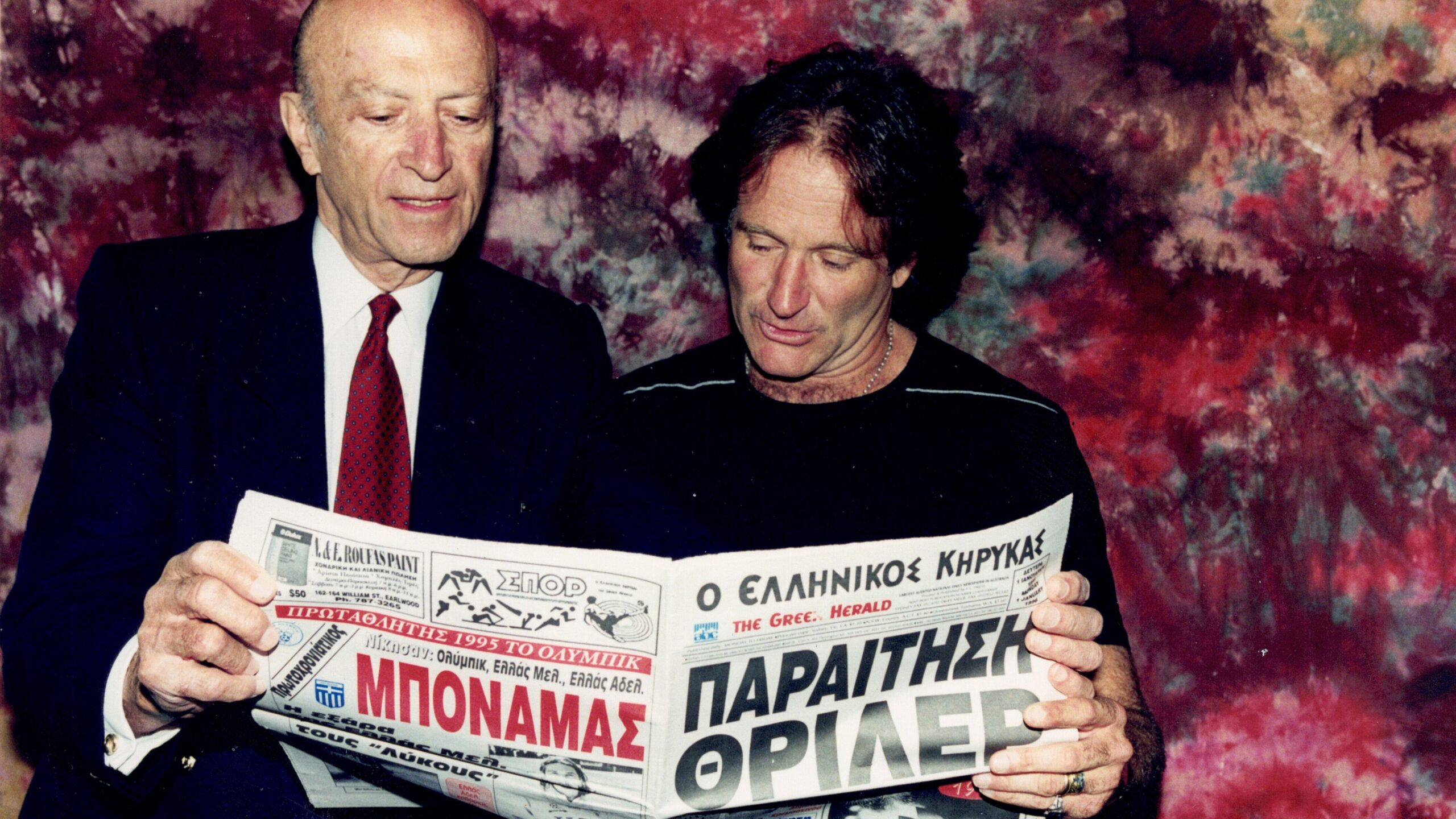
The newspaper’s expanding international reach was also reflected through permanent overseas correspondents including Kostas Alexander in Los Angeles, who between 1997 and 1998 regularly reported on Hollywood and interviewed major international figures including Leonardo DiCaprio, Dustin Hoffman, Gregory Peck, Geoffrey Rush, Arnold Schwarzenegger, and the late Robin Williams, among many others.
Artists including Anna Vissi, George Dalaras, Demis Roussos, Angela Dimitriou, Antonis Remos, Glykeria, Antonis Vardis and Lefteris Pantazis performed before huge diaspora audiences throughout Sydney and Melbourne, reflecting the scale and confidence of Greek Australian cultural life during the period.
The Greek Herald itself played a major role in promoting and supporting much of that cultural activity through media partnerships, event promotion and direct engagement with performers, promoters and cultural organisations.
Recognition across the global diaspora
By the early 2000s, The Greek Herald had itself become one of the most respected Greek-language newspapers in the global diaspora.
In July 1999, the newspaper received a formal distinction from the President of the Hellenic Republic recognising its consistency and contribution to journalism throughout the Hellenic world.
The recognition reflected the growing international profile and credibility of the newspaper.
The following year, The Greek Herald was declared the best Greek-language newspaper in the diaspora among twenty-nine international publications.
Only weeks later, Theo Skalkos formally received the distinction from President Kostis Stephanopoulos.
The award represented more than journalistic recognition.
It symbolised the transformation of The Greek Herald from a local migrant newspaper founded in Sydney in 1926 into one of the leading Greek-language media institutions outside Greece itself.
Throughout the decade, the paper increasingly positioned itself as both a historical archive of Greek Australian life and an active institutional bridge connecting Australia with Greece, Cyprus and the wider diaspora world.
The newspaper’s growing international reputation reflected not only its journalism, but its increasingly central role within diaspora public life itself.
A globally connected Greek Australia
By 2006, Greek Australia had entered a new era.
The children and grandchildren of postwar migrants had moved into positions of influence across politics, business, academia, media and public life, while remaining connected to Greece in ways unimaginable to earlier generations.
Satellite broadcasting, international travel and rapidly evolving communications transformed the diaspora into a far more interconnected Hellenic world.
The Greek Herald stood at the centre of that transformation.
Through media partnerships, international reporting, political access, cultural promotion and institutional engagement, the newspaper evolved from a traditional migrant publication into one of the leading Greek-language media institutions of the global diaspora.
The eighth decade of The Greek Herald captured the confidence, visibility and international reach of Greek Australia at the turn of the twenty-first century.
