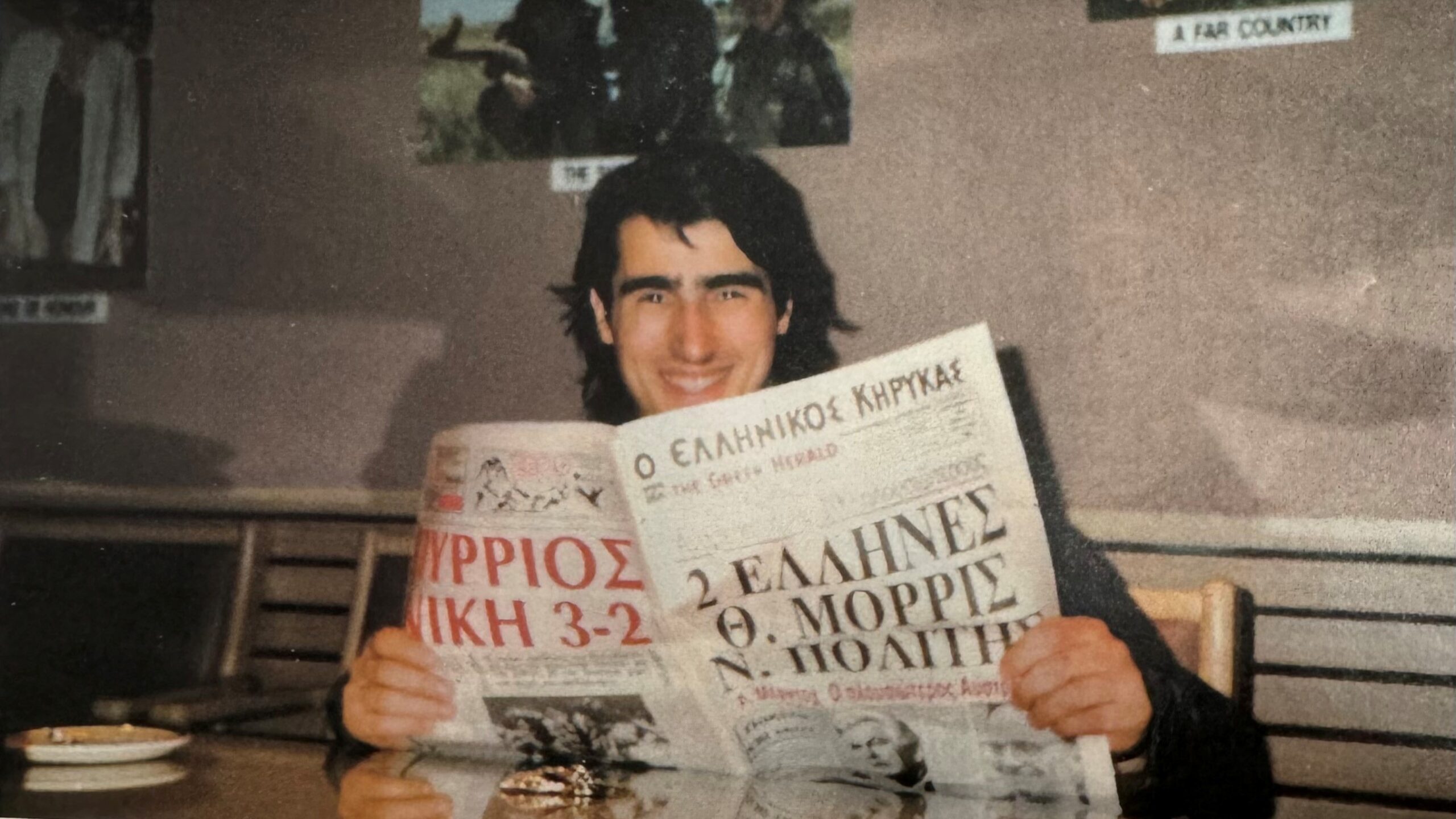
By the late 1980s, Greek Australia had entered a fundamentally different era from the fragile migrant world that had shaped the newspaper’s earlier decades.
Greek Australians had become an increasingly visible and politically influential presence with expanding educational institutions, growing business networks and stronger integration into Australian public life, while remaining deeply connected to developments in Greece, Cyprus and the wider diaspora world.
The years between 1987 and 1996 reflected that transformation.
This was the decade in which multiculturalism became embedded within Australian political life, ethnic media matured institutionally, second-generation Greek Australians increasingly entered politics and professional leadership, and the Greek state intensified efforts to engage the global diaspora.
The Greek Herald stood at the centre of those developments.
The newspaper documented the rise of Greek Australian politicians, the expansion of Greek language education, major cultural and diplomatic initiatives, the arrival of Greek financial institutions in Australia, the Macedonia mobilisations, escalating ecclesiastical conflicts and the growing political confidence of organised Hellenism in Australia.
At the same time, the newspaper itself continued evolving rapidly.
Under the leadership of Theo Skalkos, The Greek Herald expanded operationally and technologically during a period of major transformation in media production. Earlier systems heavily reliant on translated reports, phototypesetting and manually transferred material from Greece increasingly gave way to faster transmission technologies, more sophisticated newsroom processes and increasingly direct communication links with Greece, fundamentally changing the speed and scale of diaspora journalism.
The newspaper’s modernisation reflected the broader evolution of Greek Australian life itself – more confident, more connected and increasingly national in scope.
Greece reconnects with the diaspora
One of the defining developments of the late 1980s was the growing effort by the Greek state to formally reconnect with, organise and politically engage the global diaspora.
The Greek Herald extensively covered the activities of the General Secretariat for Greeks Abroad, ministerial visits to Australia, diaspora education initiatives and broader discussions surrounding the future of Hellenism outside Greece.
Senior Greek political figures increasingly treated Australia’s Greek press as an important diaspora institution during the period. Among the most notable visits covered by the newspaper was that of future Greek Prime Minister Antonis Samaras, who visited The Greek Herald offices during the 1990s as part of broader efforts to engage Greek Australians politically and culturally.
The newspaper’s growing international stature within diaspora affairs was further reflected through visits by senior dignitaries including Androulla Vassiliou, First Lady of Cyprus and wife of President George Vassiliou, who visited The Greek Herald offices during the late 1980s as Cyprus remained a central concern for Greek Australians.
These developments followed the earlier establishment of the World Council of Hellenes Abroad (SAE), described then as one of the most serious attempts to organise global Hellenism institutionally. The newspaper also documented the tensions and resistance the initiative generated within sections of the Orthodox hierarchy in Australia, reflecting broader struggles over leadership and representation within diaspora life.
A defining moment came with the Greece-Victoria Conference held in Melbourne in March 1987.
The conference, strongly promoted and documented by The Greek Herald, brought senior Greek political figures, academics, educators and community representatives together in one of the most ambitious attempts yet to strengthen structured ties between Greece and Greek Australia.
In the lead-up to the conference, the newspaper closely followed the arrival of the Greek delegation led by Georgios Papandreou and Minister for the Aegean Petros Valvis, while also reporting on the fierce political criticism the initiative attracted from opponents in Greece who viewed it as politically motivated.
The conference reflected Greece’s growing effort to formally engage the diaspora as a politically, culturally and economically significant global community. The paper also documented expanding discussions surrounding diaspora voting rights, return migration and Greek Australian investment in Greece.
Following the Greece-Victoria Conference in March 1987, a permanent educational committee was established comprising representatives from the Victorian Government, educators and Greek community figures including Panagiota Gikas, George Papadopoulos, Tassos Tamis and Stan Piperoglou, reflecting the increasingly organised institutional approach emerging around Greek language preservation in Australia.
The rise of Greek Australian political influence
The 1980s also marked a period in which Greek Australians became increasingly visible within Australian political life.
The Greek Herald closely followed the rise of Greek Australian parliamentarians, candidates and political organisers across both major parties.
Figures including Theo Theophanous, Nick Bolkus, Dimitri Dollis, Theo Sidiropoulos, Bill Kardamitsis and others appeared regularly throughout the newspaper’s coverage as Greek Australian political representation expanded nationally. In July 1987, The Greek Herald prominently reported the appointment of South Australian senator Nick Bolkus as Immigration Minister in the Hawke Government, viewing the development as another sign of the growing political influence of Greek Australians within national public life.
In 1995, Prime Minister Paul Keating publicly endorsed the candidacy of Bill Kardamitsis in the Victorian electorate of Wills, reflecting both the growing electoral importance of Greek Australian communities and the increasing prominence of Greek Australian political figures within the ALP.
In October 1988, the newspaper reported on the election victories of Greek Australian Labor figures including Dollis, Andrianopoulos and Theophanous in Victoria, reflecting the growing political confidence of second-generation Greek Australians within mainstream Australian politics.
The paper also documented preselection battles, ethnic branches within the ALP, internal factional disputes and the increasing electoral significance of migrant communities in suburban Melbourne and Sydney.
At the same time, the newspaper remained deeply attentive to Australian political attitudes toward multiculturalism and migration.
The Greek Herald strongly opposed public campaigns promoting assimilation and repeatedly defended the legitimacy of ethnic identity within Australian national life.
In May 1987, the paper reported on attempts within the Returned and Services League, led publicly by figures such as Bruce Ruxton, to push for stronger cultural and linguistic assimilation policies for migrants.
Bruce Ruxton and other conservative anti-multicultural voices appeared regularly within the newspaper’s coverage during the late 1980s as symbols of what the paper viewed as attempts to undermine multicultural Australia.
The newspaper argued forcefully that migrants could participate fully in Australian society without abandoning language, religion or cultural identity.
That position became increasingly important as Greek Australians transitioned from migrant communities into an established part of Australian public life.
The SBS struggle and ethnic media power
One of the most significant media battles of the decade centred on SBS.
The Greek Herald strongly supported the campaign to preserve the multicultural broadcaster’s independence during periods when proposals emerged to weaken SBS or integrate it into the ABC.
For Greek Australians and many other migrant communities, SBS represented far more than a broadcaster.
It symbolised the institutional recognition of multicultural Australia itself.
In April 1987, the newspaper reported that SBS would remain independent, describing the outcome as a victory for Greek and Italian migrant communities whose activism and political pressure had helped defend multicultural broadcasting.
The battle reflected both the growing political influence of ethnic communities during the Hawke era and the evolving role of ethnic media itself within debates surrounding multiculturalism, public policy and national identity.
The paper’s editorials increasingly reflected that confidence.
In May 1987, The Greek Herald also publicly rejected rumours that the newspaper was being sold, with Theo Skalkos dismissing the speculation and reaffirming the paper’s continuing role within Greek Australian public life.
In one particularly notable moment in April 1989, The Greek Herald published English-language editorials attacking SBS policies and broader media issues – a rare departure from its traditionally Greek-language editorial voice. The shift reflected the emergence of a bilingual second-generation readership and the newspaper’s growing confidence in engaging directly with mainstream Australian political and media debates.
Education and the preservation of Greek identity
Questions surrounding language and education remained central throughout the decade as concerns intensified over preserving Greek identity among younger generations entering Australian universities and professional life.
The newspaper extensively documented the expansion of Greek day schools, bilingual education programs and Modern Greek university departments throughout Australia.
In December 1985, the paper covered discussions surrounding Modern Greek studies at Macquarie University, while later reports documented the expansion of Modern Greek at UNSW and Flinders University.
The decade also saw intense debates surrounding Greek day schools.
Educational committees, community organisations and church authorities increasingly competed over the direction of Greek education in Australia.
The newspaper closely followed the establishment of new Greek day schools, including Agia Efthymia in Sydney, while also documenting the major campaign surrounding the creation of Alphington Grammar in Melbourne.
In January and February 1989, the paper reported on efforts by educationalists and community leaders to encourage the Greek Orthodox Community of Melbourne and Victoria to purchase the Alphington school site and establish what would become one of the most significant Greek schools in Australia.
The Greek Herald also documented broader educational conferences organised between Greece and the diaspora.
Educational seminars led by figures such as Theo Theophanous, as well as world conferences on Greek language education organised in Athens by Giorgos Papandreou, reflected growing concerns surrounding the preservation of Greek identity among younger diaspora generations.
The newspaper consistently framed education not simply as schooling, but as cultural survival.
The period also saw the growing prominence of longtime journalist and sporting editor Michalis Mystakidis, who had joined the newspaper in 1978 and expanded his editorial presence during the late 1980s through columns including ‘Metaxi Mas’ and ‘Kathimerina’, as well as commentary on diaspora affairs and Greek Australian public life. His growing role reflected the broader professionalisation and diversification of The Greek Herald newsroom during the Theo Skalkos era.
Macedonia, Orthodoxy and diaspora mobilisation
No national issue mobilised Greek Australians more intensely during the late 1980s than Macedonia.
As tensions surrounding the Macedonian question escalated internationally, The Greek Herald became one of the principal platforms documenting the political and cultural mobilisation unfolding throughout Greek Australia.
The paper extensively covered lectures, rallies, conferences, diplomatic interventions and public disputes connected to the issue.
In August 1986, the newspaper reported on the establishment of the Australian Institute of Macedonian Studies (AIMS) following lectures delivered at the Brunswick Greek Community.
By 1987 and 1988, the Macedonian issue had become a dominant theme throughout large sections of diaspora political life.
Archival coverage from 1996 captured the scale and emotion of the Macedonia rallies held across Australia, where thousands of Greek Australians mobilised publicly in defence of what they viewed as the historical and cultural identity of Macedonia. The demonstrations became some of the largest expressions of organised Greek Australian political activism seen during the decade.
The newspaper reported repeatedly on protests against what Greek Australians described as historical falsification by “Macedoslav” organisations, while also documenting the arrival of the major Macedonian Exhibition in Australia.
The exhibition, which displayed hundreds of archaeological and historical objects connected to ancient Macedonia, received extensive coverage throughout 1988.
The Greek Herald presented the exhibition not merely as a cultural event, but as a direct defence of the Hellenic identity of Macedonia.
The paper also documented lectures by archaeologists and academics including Manolis Andronikos and numerous political interventions by visiting Greek officials encouraging diaspora Greeks to defend “the Greekness of Macedonia.”
The intensity of the issue reflected the increasingly transnational nature of Greek Australian identity, with developments involving Greece continuing to generate strong emotional and political mobilisation throughout the diaspora.
Following the breakup of Yugoslavia between 1991 and 1994, the issue intensified dramatically, triggering some of the largest Greek Australian rallies and political mobilisations of the decade across Melbourne, Sydney and Adelaide. The Greek Herald extensively documented mass demonstrations, lobbying campaigns and public appeals urging the Australian Government not to recognise the neighbouring state under the name “Macedonia.”
In 1996, The Greek Herald extensively chronicled the historic first visit of Ecumenical Patriarch Bartholomew I to Australia, dedicating multiple front pages and special reports to the tour and its significance for the Greek Orthodox and wider Greek Australian community. Archival editions documented the Patriarch’s official meetings with Prime Minister John Howard and senior political leaders in Canberra, alongside major appearances, church services and public receptions in Melbourne and Sydney, where thousands gathered to welcome him.
The visit unfolded during one of the most emotionally charged periods for the diaspora, as tensions surrounding Macedonia sparked mass rallies across Australia and fierce debate within sections of the community. Through prominent headlines, community reporting and extensive coverage of the rallies in Melbourne and Sydney, The Greek Herald captured both the pride and tensions that defined Greek Australian public life during the mid-1990s. The newspaper also documented Archbishop Stylianos’ repeated appeals for reconciliation and restraint amid fears of deepening division within the diaspora.
The Bicentenary and the arrival of Aris
The Australian Bicentenary year of 1988 became one of the most symbolically significant periods for Greek Australia during the decade.
The arrival of the Greek naval destroyer Aris during Australia’s Bicentennial celebrations in 1988 generated enormous excitement throughout Greek Australian communities in Melbourne and Sydney.
The Greek Herald devoted extensive coverage to the ship’s arrival, the ceremonial processions, community receptions and public celebrations surrounding the event.
Thousands of Greek Australians gathered as crew members marched through central Sydney carrying Greek flags in front of huge crowds during the Bicentennial festivities.
The newspaper described the occasion as a moment of enormous pride for Greek Australia.
The accompanying archival photographs published by the paper became some of the defining visual records of Greek Australian public life during the era.
Throughout 1987 and 1988, the newspaper documented fundraising campaigns, planning and eventually the opening of the Australian Hellenic Memorial in Canberra, which formally recognised the wartime alliance and shared sacrifices between Greece and Australia. The Greek Herald extensively covered the participation of political leaders including Bob Hawke and representatives of the Greek Government, while for many within the diaspora the memorial symbolised Greek Australians becoming part of the national Australian story itself.
Greek banks, business confidence and economic expansion
The decade also reflected growing economic confidence within Greek Australian life.
Greek banks including Laiki Bank, Bank of Cyprus and Ktimatiki Bank established operations in Australia during the late 1980s, reflecting the growing financial confidence and institutional maturity of Greek Australian life.
The Greek Herald followed these developments closely, viewing them as evidence of the diaspora’s transition from migrant labour into business ownership, investment and broader economic influence within Australia.
Laiki Bank would later evolve into what is now known as “Bank of Sydney”, one of the most recognisable banking institutions connected to the Greek Australian community today.
The arrival of Greek financial institutions also strengthened commercial links between Greece, Cyprus and Australia while symbolising the growing purchasing and investment power of Greek Australians themselves.
The newspaper’s entertainment pages during the period reflected the enormous scale of Greek cultural life in Australia. In some editions during the late 1980s, The Greek Herald carried full pages advertising Greek musical bands performing across Sydney, while almost 30 additional bands and performers were active throughout Melbourne alone, highlighting the extraordinary size of the Greek entertainment and nightlife scene during the era.
The paper also documented major business and investment conferences involving Greek Australian entrepreneurs and Greek Government representatives.
In September 1987, The Greek Herald covered the First Australia-Greek Commercial and Investment Conference in Athens attended by large delegations of Australian and Greek Australian business figures.
The newspaper increasingly portrayed Greek Australians not only as migrants or workers, but as investors, developers, professionals and major contributors to Australian economic life.
Dukakis, Kouros and diaspora pride
The late 1980s also produced powerful moments of symbolic pride for the Greek diaspora globally.
One of the most significant was the rise of Greek American politician Michael Dukakis during the 1988 United States presidential election.
The Greek Herald followed Dukakis’ campaign intensely throughout 1987 and 1988.
The newspaper regularly published polling analysis, campaign coverage, interviews and political commentary surrounding his presidential bid.
In February 1987, the paper also prominently reported former Prime Minister Gough Whitlam’s support for the return of the Parthenon Marbles to Greece, reflecting the increasingly international nature of diaspora cultural advocacy.
For many Greek Australians, the possibility of a Greek American president represented a deeply symbolic moment for Hellenism abroad.
The paper documented the extraordinary enthusiasm the campaign generated throughout diaspora communities internationally, while also covering the eventual decline of Dukakis’ campaign against George Bush.
Sport also became an important source of diaspora identity and pride during the decade.
The Greek Herald closely followed the achievements of Greek ultra-marathon runner Yiannis Kouros, whose extraordinary long-distance endurance performances attracted huge admiration within the Greek Australian community.
The paper repeatedly documented Kouros breaking world records, being welcomed by thousands of supporters in Melbourne and eventually settling permanently in Australia.
His achievements became symbolic of both Greek endurance and migrant success within Australia.
The newspaper also continued its extensive sporting coverage of Greek Australian soccer clubs including South Melbourne Hellas and Sydney’s Alexandros, reflecting the central role football continued to play within Greek Australian communal life.
Ecclesiastical conflict and communal division
Despite the broader institutional growth of Greek Australia during the period, the late 1980s were also marked by escalating tensions between sections of the organised communities and the Archdiocese.
The Greek Herald documented increasingly bitter disputes involving Archbishop Stylianos Charkianakis, supporters of Apostolos Pavlos, community federations and broader debates over authority, representation and communal autonomy.
Throughout 1987, 1988 and 1989, the paper regularly reported on rallies, public protests, ecclesiastical disputes and demands by sections of the community for intervention by the Ecumenical Patriarchate. Many of the disputes centred on questions of authority over churches, education, communal assets and the broader relationship between the Archdiocese and traditionally independent Greek community organisations across Australia.
The disputes exposed deep divisions within organised Greek Australian life during the late 1980s.
As had often been the case throughout its history, The Greek Herald remained deeply intertwined with the communal and political struggles unfolding within Greek Australia itself.
A confident and permanent Greek Australia
By the early 1990s, Greek Australia had become an organised, politically visible and institutionally confident presence within Australian public life. The Greek Herald both documented and helped shape that transformation through a decade marked by multicultural consolidation, political influence, cultural mobilisation and the continued evolution of Greek Australian identity.
