By the late 1970s, Greek Australia was entering a decisive period of transition. The mass migration wave that had transformed Australia after the Second World War was slowing, but the institutions built by those migrants – churches, communities, newspapers, schools, businesses and sporting clubs – were becoming larger, more organised and increasingly influential within Australian public life.
The years between 1977 and 1986 captured Greek Australia moving beyond survival and settlement into a new era of institutional consolidation, political activism and cultural confidence. The decade was also marked by intense communal disputes, rapid technological change within ethnic media and growing efforts by Greece itself to reconnect with the diaspora.
At the centre of those developments stood The Greek Herald.
Under the increasingly dominant leadership of Theo Skalkos, the newspaper expanded operationally, politically and editorially while undergoing major technological and structural change.
A community comes of age
The symbolic beginning of the decade came in January 1977, when The Greek Herald celebrated its 50th anniversary with a major official reception at Sydney’s Wentworth Hotel.
Hosted by Theo and Eleni Skalkos, the event drew leading political, diplomatic and communal figures including NSW Premier Neville Wran, Opposition Leader Sir Eric Willis and senior representatives of the Greek Australian community.
The celebrations reflected the newspaper’s transformation from a fragile migrant publication into one of the most significant Greek language institutions in Australia.
The anniversary also attracted mainstream Australian attention.
Channel 2 journalist John Lawler produced a television segment on the newspaper and its operations, featuring interviews with George Messaris and footage from the paper’s premises and newsroom – a rare recognition of Greek ethnic media within mainstream Australian broadcasting during the period.
The broader Greek Australian community itself was also changing rapidly.
Second-generation Greek Australians were increasingly entering universities, professional life, politics and public institutions, while community organisations expanded nationally in size and sophistication.
The newspaper closely followed the emergence of student activism and younger leadership during the decade.
In January 1977, former Prime Minister Gough Whitlam addressed the 8th National Congress of Greek Australian Students at the University of Melbourne before more than 400 students and community figures including Nicholas Zervos and Anastasios Tamis.
The congress highlighted the growing political and educational confidence of second-generation Greek Australians.
At the same time, Greek Australians were becoming increasingly visible within Australian political life itself.
The newspaper documented the rise of Greek Australian councillors, political organisers and parliamentarians across Sydney and Melbourne, including Theo Sidiropoulos, who in September 1977 became the first Greek mayor of Collingwood in Melbourne.
The paper also closely followed the growing electoral importance of migrant communities within Australian politics and repeatedly defended multiculturalism against assimilationist attitudes.
In October 1980, The Greek Herald highlighted the existence of discriminatory legislation dating back to 1701 which restricted access to public office for people not born in Britain or its colonies, using the example to criticise lingering structural prejudice within Australian political culture.
Multiculturalism and ethnic media
The late 1970s and early 1980s were also foundational years for multicultural broadcasting and ethnic media in Australia.
In November 1977, the first Greek television program in Australia, Greek Affair, aired on Channel 10 under the presentation of Sandall Kountouris and Harry Michael through Ethnic TV Productions.
The emergence of Greek-language television represented a major cultural milestone for the community and reflected the broader expansion of multicultural broadcasting nationally.
Throughout the late 1970s and early 1980s, The Greek Herald strongly defended multicultural broadcasting amid ongoing political debates surrounding the future of SBS and ethnic media in Australia. The newspaper repeatedly argued that migrant communities required access to language-specific broadcasting in order to preserve cultural identity and maintain democratic representation within Australian public life.
At the same time, The Greek Herald itself was transforming technologically.
In January 1978, the newspaper announced the introduction of revolutionary new transmission systems linking Sydney, Melbourne and Athens, allowing readers in Australia to access news from Greece almost immediately after events occurred.
The paper declared proudly that Greek Australians would now read news “today that Greeks in Greece will read tomorrow.”
The technological changes fundamentally altered the nature of diaspora journalism. By the late 1970s, the newspaper had increasingly shifted away from heavily Australian-centred reporting toward faster Greece-based news coverage using offset printing and imported material transmitted directly from newspapers in Greece and Cyprus.
In February 1978, The Greek Herald also became one of the first Greek-language newspapers to formally adopt the monotonic Greek writing system, describing the reform as “a national necessity.”
The period additionally reflected the growing influence of Theo Skalkos within the newspaper itself.
In July 1978, the paper officially changed its logo from Panellinios Kiryx to Panellinios Kirykas, while Skalkos formally appeared in the masthead as Managing Director. The paper simultaneously expanded its interstate operational presence through offices in Melbourne and Adelaide.
The newspaper also increasingly promoted itself as a national institution representing the entirety of Greek Australia.
The launch of the Panhellenic Business Guide of Australia in 1979 reflected that ambition.
The large-scale commercial directory documented Greek businesses nationally and presented Greek Australians not simply as migrants or labourers, but increasingly as business owners, professionals and economic contributors to Australian society.
The period was not without operational setbacks.
In September 1978, a fire partially destroyed The Greek Herald’s computer centre and forced the newspaper to temporarily reduce its page count, highlighting both the rapid technological modernisation underway and the growing dependence of ethnic media on new production systems.
The paper’s growing influence within Australian public life was further reflected in February 1979 when Prime Minister Malcolm Fraser visited The Greek Herald offices, meeting with Theo Skalkos and wider team.
Greek language and educational expansion
Questions surrounding language and education became some of the defining communal debates of the decade, with The Greek Herald extensively documenting the expansion of Greek day schools, bilingual education programs, Modern Greek university departments and educational institutions across the country.
In March 1977, the Greek Community of Brunswick opened one of Melbourne’s first purpose-built Greek educational facilities under the leadership of Elias Rentzis and headmaster Anastasios Tamis.
The same year also saw the establishment of the Modern Greek Teachers Association of NSW following initiatives led by teacher Antonios Papadimitriou.
Universities increasingly became central battlegrounds for Greek language education.
The newspaper documented major campaigns surrounding Modern Greek at the University of Sydney, Monash University and Melbourne University throughout the late 1970s and early 1980s.
In 1977, enrolments in Modern Greek at the University of Sydney reportedly increased by 40 per cent, reflecting growing student demand.
The Greek Government also expanded its educational presence within Australia during the period.
In late 1977, Greece appointed its first Educational Consuls to Australia, establishing a system that would shape Greek language education nationally for decades.
The paper closely followed broader debates surrounding bilingualism and multicultural education as state schools increasingly introduced Greek language programs.
By the early 1980s, bilingual education programs supported by the Greek Orthodox Community of Melbourne and Pronoia were beginning to emerge within Victorian state schools, while communities in Sydney campaigned for Modern Greek classes in public schools including West Marrickville Primary.
The newspaper consistently framed education not simply as schooling, but as cultural continuity and communal survival.
Greece, Cyprus and diaspora politics
Throughout the decade, The Greek Herald maintained intense engagement with developments in Greece, Cyprus and the Eastern Mediterranean.
The paper extensively covered Greco-Turkish tensions, Cyprus, NATO disputes, the Aegean issue and the preservation of Hellenism in Constantinople and Macedonia.
The death of Archbishop Makarios in August 1977 generated enormous emotional response throughout Greek Australia.
The newspaper devoted extensive front-page coverage to his death, funeral and political legacy, while also publishing personal letters sent by Makarios directly to Skalkos and the newspaper itself in recognition of its support for Cyprus.
The paper’s relationship with Greece also deepened significantly during the period through repeated visits by Greek ministers, diplomats and parliamentary delegations.
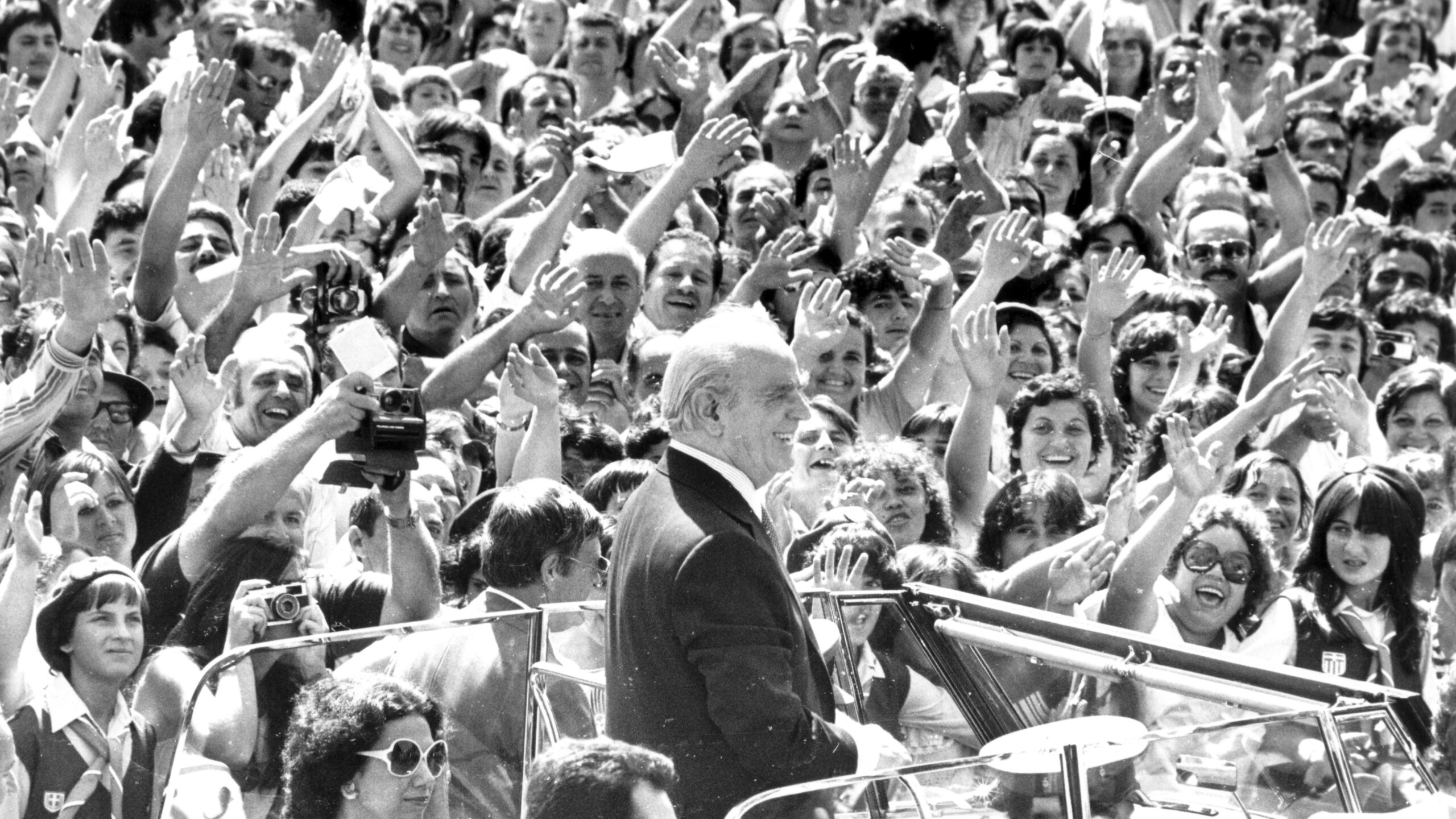
The strengthening relationship between Greece and the diaspora reached its emotional peak during the 1982 visit of President of the Hellenic Republic Konstantinos Karamanlis. The Greek Herald devoted extensive coverage to the unprecedented public response, describing how “Greeks by the thousands” gathered to express their respect for the Greek President during his Australian visit. In Melbourne alone, the paper reported that more than 100,000 Hellenes welcomed Karamanlis in one of the largest public mobilisations in the history of Greek Australia.
In 1977, Deputy Foreign Minister Konstantinos Trikoupis toured Australia and announced major cultural and educational agreements between Greece and Australia. The following years saw continued visits by Greek officials connected to education, culture and diaspora affairs.
During the same period, the newspaper framed Greek National Day celebrations as symbols of the maturity and permanence of the diaspora, declaring in 1982 that “it is only with enormous pride that the Greeks of Australia celebrate the Greek National Day.” The language reflected the growing confidence of a community that increasingly saw itself as both proudly Australian and deeply connected to Greece.
The paper also extensively covered Greece’s accession into the European Economic Community in December 1978, presenting the development as a major national and geopolitical milestone for Hellenism.
At the same time, the newspaper increasingly documented the rise of Macedonia-related activism within the diaspora.
In November 1977, extensive coverage was devoted to the archaeological discoveries at Vergina by Professor Manolis Andronikos, while later reports documented growing concern surrounding “Macedoslav” activism internationally.
These issues would intensify dramatically in the following decade.
The paper additionally followed the first major discussions surrounding voting rights for expatriate Greeks.
In March 1980, The Greek Herald reported on early proposals allowing diaspora Greeks to vote in Greek elections – a debate that would continue for decades.
The Skalkos-Stylianos conflict
No issue dominated the internal communal life of Greek Australia more intensely during the late 1970s and early 1980s than the escalating conflict between Theo Skalkos and Archbishop Stylianos Charkianakis.
What began as disagreements surrounding church authority and communal control rapidly evolved into one of the most divisive public disputes in the history of Greek Australia.
Throughout the decade, The Greek Herald published extensive criticism of Archbishop Stylianos, his administration and the expanding authority of the Archdiocese.
Central issues included control of church property, communal autonomy, Greek education and the role of the Archdiocese within organised Greek Australian life.
The conflict intensified dramatically after disputes surrounding Theo Skalkos’ proposed bilingual school project in Marrickville.
According to reporting published by the newspaper in 1979, Archbishop Stylianos had indicated support for the project only if the property was eventually transferred into the Archdiocese Property Trust.
Skalkos rejected the proposal and relations between the two men deteriorated rapidly.
The newspaper increasingly published open letters, editorials, leaked correspondence and attacks against the Archbishop and sections of the hierarchy.
The disputes extended across Sydney and Melbourne and involved clergy, community organisations, congregations and even visiting representatives from the Ecumenical Patriarchate.
Public confrontations became increasingly dramatic.
In November 1979, members of a congregation at St Nektarios Church in Burwood, Sydney, reportedly threw yoghurt at Archbishop Stylianos during a church dispute connected to the exile of priest Ezekiel Petritsis.
The Greek Herald extensively documented the incident and the wider communal tensions surrounding it.
The newspaper framed the conflict as a struggle over communal autonomy and freedom of expression, while critics accused the paper of fuelling division and instability within the community.
The disputes exposed the increasingly fractured and politically charged nature of organised Greek Australian life during the period.
Greek culture, festivals and entertainment
The decade also witnessed an extraordinary expansion of Greek cultural life throughout Australia.
The newspaper’s entertainment pages reflected the enormous scale of Greek nightlife, theatre and touring performances during the era.
Artists including Maria Farantouri, Marinella, Demis Roussos, Yiannis Parios, Haris Alexiou, Lakis Chalkias, Poly Panou, Anna Fonsou and Kostas Voutsas toured Australia during the late 1970s and early 1980s before enormous diaspora audiences.
The Greek Festival Week in Melbourne became one of the major annual cultural events of the community, drawing large audiences and prominent performers.
In 1978, Melbourne Lord Mayor Irving Rockman announced the establishment of a sister-city relationship between Melbourne and Thessaloniki during Greek Festival Week celebrations, symbolising the growing institutional confidence and visibility of Greek Australia.
The paper also extensively documented the growth of Greek theatre in Australia.
Groups including Laiki Skini and Theatro Technis staged regular productions in Melbourne and Sydney, while figures such as Thanasis Papastergios established theatrical schools and artistic programs for younger Greek Australians.
Sport also became an increasingly important expression of diaspora identity.
In June 1978, the Greek national soccer team toured Australia, while Greek-backed clubs including Sydney Olympic and Heidelberg Alexander expanded dramatically in popularity and professionalism. In the same period, Sydney Olympic secured one of the largest ethnic sporting sponsorships of the era through a major agreement with Patra Orange Juice.
The decade reflected the growing scale and confidence of Greek Australian cultural life, with communities increasingly building enduring institutions within Australia.
Community growth, welfare and social change
The decade also revealed major social transformations within Greek Australian life, with the newspaper increasingly documenting issues surrounding ageing migrants, pensions, welfare services and the needs of older first-generation Greeks who had now spent decades in Australia.
In February 1977, Spyros Moraitis and Kevin Zervos helped establish one of the first Greek child-minding centres in Richmond with the support of hundreds of volunteers. The centre later attracted a visit from Prime Minister Malcolm Fraser himself.
The newspaper also followed broader social debates emerging within Australian society itself.
Issues surrounding homosexuality, discrimination, migrant rights and racism increasingly appeared within the paper’s coverage during the late 1970s.
At the same time, Greek Australians continued facing major economic and political challenges.
The notorious “Kolpo” pensions scandal became one of the most controversial migrant issues of the era after thousands of Greek pensioners were accused of welfare fraud in what later emerged as a deeply flawed and sensationalised investigation.
The newspaper strongly defended the Greek community throughout the affair and repeatedly attacked both mainstream Australian media and sections of government for their handling of the case.
By 1979, the Federal Government had formally withdrawn many of the accusations, effectively confirming the collapse of the scandal.
The episode profoundly shaped Greek Australian attitudes toward Australian institutions, policing and media representation during the period.
The decade also reflected changing gender and workforce realities within the migrant community itself.
In 1977, nearly half of Greek women in Australia were recorded as participating in the workforce – among the highest rates of employment of any migrant group in the country – highlighting the increasingly permanent and economically integrated nature of Greek Australian life.
A more confident and permanent Greek Australia
By the mid-1980s, Greek Australia had evolved into an organised and increasingly influential presence within Australian public life.
Through years marked by multiculturalism, political activism, educational expansion and communal conflict, The Greek Herald both documented and helped shape that transformation. The decade captured the moment Greek Australia began emerging not simply as a migrant community, but as a permanent and institutionally confident part of modern Australian society.
