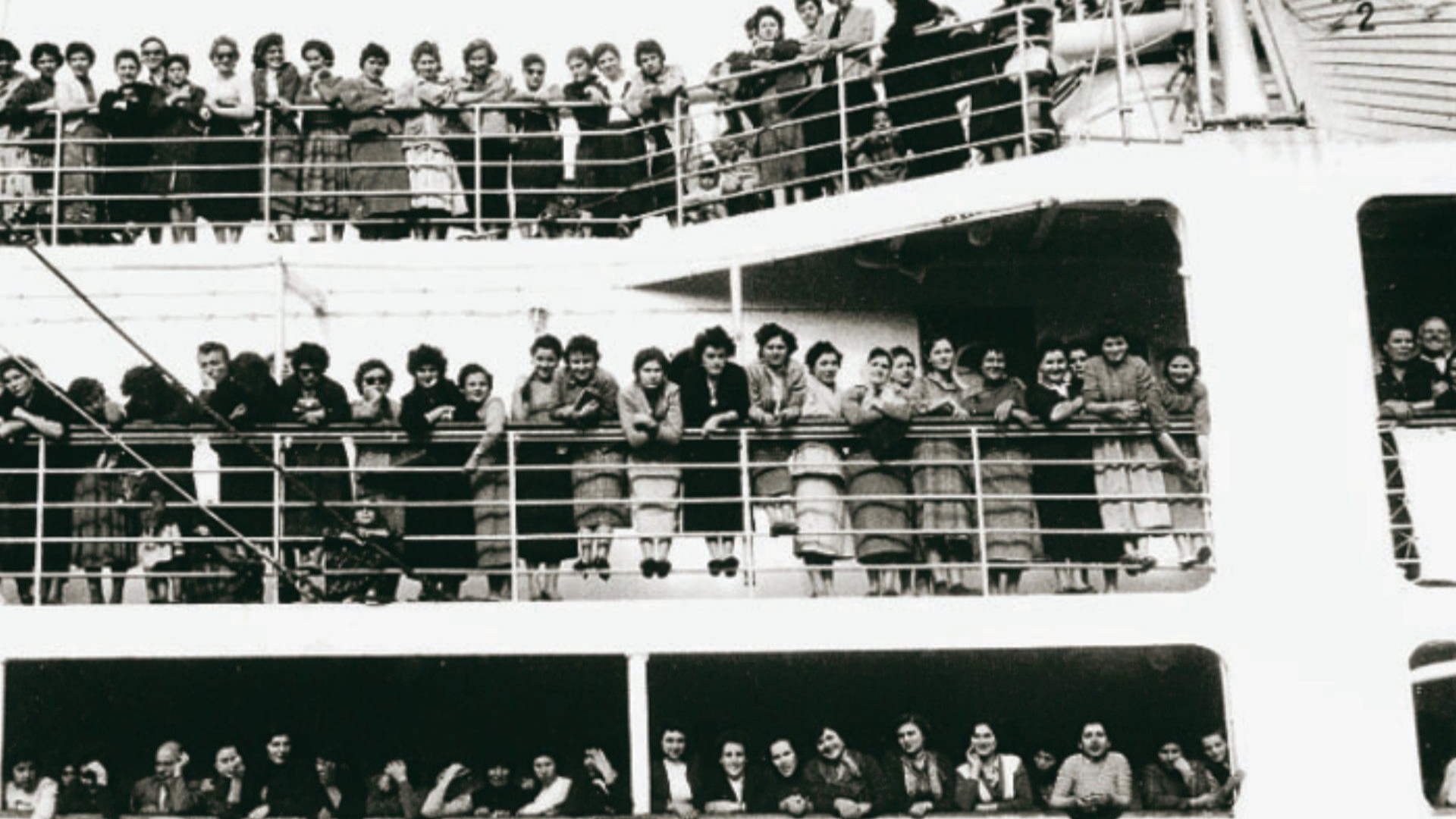
The decade between 1957 and 1966 transformed Greek Australia permanently. What had once been a relatively small migrant population centred around cafés, shops and isolated regional communities rapidly evolved into one of Australia’s largest and most organised migrant communities.
Mass post-war migration reshaped the Greek presence across the country. Thousands of new arrivals poured into Sydney, Melbourne, Adelaide, Brisbane and regional centres seeking employment, stability and opportunity, while The Greek Herald increasingly became both a guide and advocate for migrants attempting to navigate an unfamiliar country.
The decade witnessed the emergence of Greek Australia not simply as a migrant population, but as an organised communal force with churches, welfare organisations, sporting federations, schools, political influence and increasingly ambitious public institutions.
Migration dominated the pages of The Greek Herald throughout the period. In January 1957, the newspaper reported that Australia urgently required Greek women aged between 21 and 34 under assisted migration schemes organised through DEME, with applicants receiving government-supported migration arrangements to work in Australian households.
The paper closely followed the dramatic growth of migration inflows. By May 1957, Greek and Australian authorities had agreed to send more than 11,500 assisted Greek migrants to Australia in a single year, while by the end of 1958 local Hellenism was estimated to have surpassed 120,000 people nationally.
The consequences of migration were felt everywhere throughout the community. Entire islands were being emptied by migration, with The Greek Herald reporting in 1957 that Kastellorizo and Halki had lost the overwhelming majority of their populations as thousands departed for Australia and other migrant destinations.
While migration offered opportunity, the newspaper also documented the hardship, loneliness and social dislocation experienced by many arrivals. Reports throughout the decade described unemployment, factory labour, overcrowded housing, gambling, family separation and the emotional strain of adaptation.
One of the decade’s strongest recurring themes involved the vulnerability of migrant women. The newspaper repeatedly reported concerns surrounding abandoned wives, deserted families and the treatment of newly arriving brides. In March 1957, The Greek Herald reported allegations that several newly arrived Greek women without relatives in Sydney had fallen victim to exploitation shortly after arriving at Mascot Airport.
Throughout the period, the paper strongly advocated for greater protection and support structures for women migrants. In July 1957, Michael Malachias wrote that Greek women would become “the backbone of future Greek families and society” in Australia and required proper protection and support.
The emotional strain of migration also became increasingly visible throughout the newspaper’s reporting. Stories covered unemployment, suicides, abandoned families, dowry disputes and growing concerns surrounding the vulnerability of newly arrived women migrants.
The arrival of migrant brides became one of the defining images of the era. In August 1958, the Italian liner Toscana arrived in Sydney carrying approximately 600 Greek brides travelling to Australia to marry men who had previously migrated alone, one of the largest and most symbolic migrant bride arrivals covered by the newspaper during the decade.
As migration accelerated, The Greek Herald increasingly argued that older communal structures were incapable of supporting the needs of the rapidly expanding population. In January 1957, Alexandros Grivas and the newspaper strongly supported proposals for the establishment of an organised Greek Australian Welfare Society to assist newly arrived migrants, particularly women and families.
The proposed Ελληνο-Αυστραλιανό Κέντρο Προνοίας και Εξυπηρέτησης was among the earliest organised welfare initiatives developed specifically for Greek migrants in Australia. Community leaders Georgios Floros, Efstathios Anastasopoulos and Vlassis Plethakis were instrumental in the initiative, while the newspaper devoted extensive editorial support to the proposal.
The paper also supported the establishment of employment offices, welfare agencies and medical services for struggling migrants.
Welfare, communal organisation and church conflict
In April 1957, the Greek Orthodox Community of New South Wales established one of the first employment agencies for Greek migrants in Australia, while discussions also emerged regarding the creation of community medical centres for destitute immigrants.
At the same time, the newspaper increasingly reflected the tensions emerging within a rapidly expanding and politically fragmented community. Throughout the decade, fierce disputes developed between church authorities, community organisations and rival leadership factions over authority, governance and the future direction of Greek Australia.
The relationship between the Greek Orthodox Archdiocese and the organised communities became one of the defining issues of the period. Archbishop Theophylactos remained a deeply divisive figure throughout much of the decade, with The Greek Herald frequently criticising his administration and openly supporting the authority and independence of the historic Greek communities.
Conflicts involving figures such as Ierotheos Kourtessis, Methodios Livanos and Daniel Karamanlis generated major communal disputes, court battles and accusations of schism. The newspaper closely covered controversies surrounding canonical recognition, church administration and the growing struggle for influence between ecclesiastical and communal leadership.
These tensions culminated in June 1958 with the first Pangoinotikon Synedrio, or Pan-Communal Congress, held in Sydney. Delegates from Greek communities across Australia assembled to discuss the future organisation of Greek communal life and to balance the growing influence of the church hierarchy.
Following the congress, delegates established the Federation of Greek Orthodox Communities of Australia, one of the most significant institutional developments in the history of organised Greek Australia. Delegates from nineteen communities participated in the congress at the ANZAC Auditorium in Sydney, while leaders including Konstantinos Stamatiadis, Michael Vidalis, Takis Kaldis, Dimitris Elefantis and Floros Demetriades played important roles in the federation’s formation.
The decade also witnessed the rapid expansion of churches, parish communities and communal infrastructure across Australia. New churches were established in Redfern, Rose Bay, Hobart, Perth, Adelaide and Canberra as the growing migrant population spread beyond the traditional inner-city centres.
The death of Archbishop Theophylactos in August 1958 became one of the most significant communal events of the decade. The Greek Herald provided extensive coverage of his death, funeral and the arrival of Archbishop Athenagoras from Thyateira as temporary administrator of the church in Australia.
The arrival of Archbishop Ezekiel
The ecclesiastical tensions of the late 1950s did not subside following the death of Archbishop Theophylactos. Instead, they entered a new and even more consequential phase with the arrival and enthronement of Archbishop Ezekiel Tsoukalas in 1959.
The Greek Herald initially welcomed Ezekiel enthusiastically, publishing supportive front-page coverage of his arrival and presenting him as a figure capable of restoring unity and stability within the rapidly expanding Greek Orthodox Archdiocese of Australia.
During Ezekiel’s early months in Australia, Alexandros Grivas and the newspaper closely accompanied the Archbishop through official meetings with political and communal leaders, including Sydney Lord Mayor Harry Jensen and NSW Premier Joseph Cahill. Yet as the decade progressed, deeper disputes surrounding parish authority, communal governance and ecclesiastical control increasingly brought the Archdiocese into conflict with the historic Greek Communities and Federation leadership.
Under Ezekiel, the Archdiocese moved toward a more centralised structure, asserting greater authority over the establishment and administration of churches and limiting the independent role historically exercised by the Communities.
These developments intensified existing divisions in Adelaide, Melbourne and Sydney, where disputes surrounding clergy appointments, parish control and communal autonomy evolved into some of the most serious schisms in post-war Greek Australian history.
Throughout this period, The Greek Herald remained strongly aligned with the historic Community movement and frequently defended the authority of the organised Communities against what it viewed as excessive ecclesiastical centralisation.
The newspaper’s editorials, particularly under Grivas, became deeply intertwined with the broader struggle over the future structure and leadership of Greek Australian communal life.
Cyprus and political mobilisation
Alongside internal communal tensions, Cyprus increasingly emerged as one of the defining political causes uniting Greek Australians nationally. The newspaper devoted enormous attention to the EOKA struggle, the exile and eventual release of Archbishop Makarios, debates at the United Nations and the broader deterioration of Greco-Turkish relations.
Mass meetings, rallies and fundraising campaigns in support of Cyprus took place across Australia. The Greek Herald extensively covered lobbying efforts by Greek Australian leaders who travelled to Athens and London advocating for Cypriot self-determination.
Australian political figures including Dr H. V. Evatt and Clive Evatt became prominent supporters of Cyprus within Australian public life. The newspaper repeatedly praised their philhellenic support and their backing of Cypriot self-determination.
Racism, citizenship and belonging
At the same time, broader questions surrounding migration, citizenship and racial discrimination increasingly entered public debate. The Greek Herald documented prejudice against Southern European migrants and criticised discriminatory attitudes within sections of Australian society. In one editorial discussing migrant unemployment and discrimination, the newspaper urged Australians to remember that migrants were “not savages.”
In February 1958, the newspaper welcomed the abolition of the Dictation Test, one of the foundational mechanisms underpinning the White Australia Policy. The paper also strongly criticised employment discrimination against migrants during periods of unemployment and condemned attempts to portray Greek migrants as socially inferior.
Questions surrounding naturalisation and citizenship rights also emerged repeatedly throughout the decade. The newspaper warned that naturalised Australians remained vulnerable to unequal treatment under Australian law and argued that migrants must increasingly recognise Australia as their permanent home.
In July 1958, Alexandros Grivas openly acknowledged that Greek migration to Australia was no longer temporary and that Greeks had become citizens of Australia whose future now rested permanently in the country.
The rise of The Greek Herald
Throughout the decade, The Greek Herald itself increasingly evolved into one of the most influential institutions within Greek Australian life. Under the leadership of Alexandros Grivas, the newspaper became deeply involved in virtually every major communal, national and political issue affecting the diaspora.
Grivas emerged as one of the most influential personalities within Greek Australia. His editorials shaped communal debates on migration, church authority, Cyprus, welfare, education and the future direction of Hellenism in Australia.
The newspaper also increasingly engaged in broader national advocacy. During his 1957 travels to Greece and the United States, Grivas met leading Greek political figures including Prime Minister Konstantinos Karamanlis, government ministers and diplomatic representatives to discuss migration, transport links and diaspora affairs.
The Greek Herald strongly advocated for improved transport connections between Australia and Greece. During his 1957 travels to Greece, Alexandros Grivas discussed migration and transport issues with senior political and diplomatic figures, while the newspaper repeatedly highlighted the emotional and practical importance of faster travel links for separated migrant families.
The newspaper later celebrated the establishment of QANTAS flights connecting Sydney and Athens in June 1957, describing the route as a historic breakthrough that dramatically reduced travel time between Australia and Greece.
The paper also increasingly reflected the growing confidence and visibility of Greek Australians within Australian public life.
The newspaper itself was expanding rapidly. By 1958, increasing advertising revenue and growing readership frequently pushed editions to ten pages, while new reader initiatives including “Letters to the Editor” increasingly turned HH into a communal public forum.
The period also saw early experimentation with English-language content and broader Australian commentary, foreshadowing the bilingual and outward-looking direction the newspaper would later adopt more fully. By the late 1950s, Greek Australians were beginning to emerge as professionals, business owners, political candidates and public figures.
In November 1958, Georgios Xiros became the first Greek Australian candidate to stand in a federal election, contesting the Victorian electorate of Mallee for the Australian Labor Party.
Sport, culture and communal identity
Cultural and sporting life expanded dramatically during the decade. Greek theatres, music performances, amateur dramatic groups and sporting clubs multiplied rapidly throughout Australia as migrants attempted to recreate a sense of community and familiarity.
The Panhellenic Athletic Games became major national gatherings bringing together Greek sporting clubs from across Australia. The establishment of the Panhellenic Athletic Federation of Australia in 1957 reflected the increasing organisation and ambition of Greek sporting life.
Football clubs including Pan-Hellenic (later Sydney Olympic), Olympiakos, Ellinikos and numerous regional Greek sporting associations rapidly evolved into major social and cultural institutions linking migrants through sport, language and communal identity. The newspaper also introduced dedicated sporting coverage through columns such as Athlitika Nea.
Major Greek performers including Sofia Vembo and Anna and Maria Kalouta toured Australia before large migrant audiences, reflecting the growing confidence and cultural sophistication of migrant communities across the country.
Education and identity
The newspaper also documented growing concerns surrounding language preservation, education and assimilation. Community leaders increasingly feared that younger generations would lose the Greek language and weaken their connection to Hellenic identity.
Greek schools expanded throughout the country while Greek language teachers, catechism schools and educational campaigns became increasingly prominent in community life. The newspaper frequently warned against the erosion of Greek language within churches and migrant families.
At the same time, the decade witnessed the emergence of a more confident and permanent Greek Australian identity. What had once been viewed by many migrants as a temporary exile increasingly became understood as a long-term national community.
By the end of the decade, Greek Australians had established welfare centres, churches, schools, sporting federations, interstate congresses and increasingly influential communal organisations.
The foundations of modern Greek Australia had been firmly established.
The Grivas succession and a new generation of leadership
The final years of the decade also marked the beginning of a major transition within The Greek Herald itself. Alexandros G. Grivas — who had guided the newspaper for decades as manager, administrator, co-proprietor and eventually principal proprietor — remained one of the dominant figures in Greek Australian communal life until his death on 28 January 1963.
His passing closed one of the foundational eras of both the newspaper and organised Greek Australian public life. Yet the transition within the paper was carefully maintained through the continued involvement of the Grivas family and senior editorial figures already closely connected to the operation. His son, Nestor A. Grivas, assumed the role of Managing Director and Editor from 1963, helping oversee the newspaper during a period of rapid migration growth, political change and evolving communal priorities.
Alongside Nestor Grivas, figures including Dimitris (James) Kalomoiris and Angelos Kourlios increasingly emerged within the managerial and editorial structure that would guide the newspaper into the later 1960s and eventually toward the transformative Skalkos era.
In July 1958, the name Theo Skalkos appeared in The Greek Herald for the first time through an advertisement for Theo’s Driving School in Waterloo – a small but historic archival moment that would later become deeply intertwined with the newspaper’s own future.
The Greek Herald stood at the centre of that transformation, documenting, advocating for and helping shape one of the most important periods in the history of the Greek Australian diaspora.
