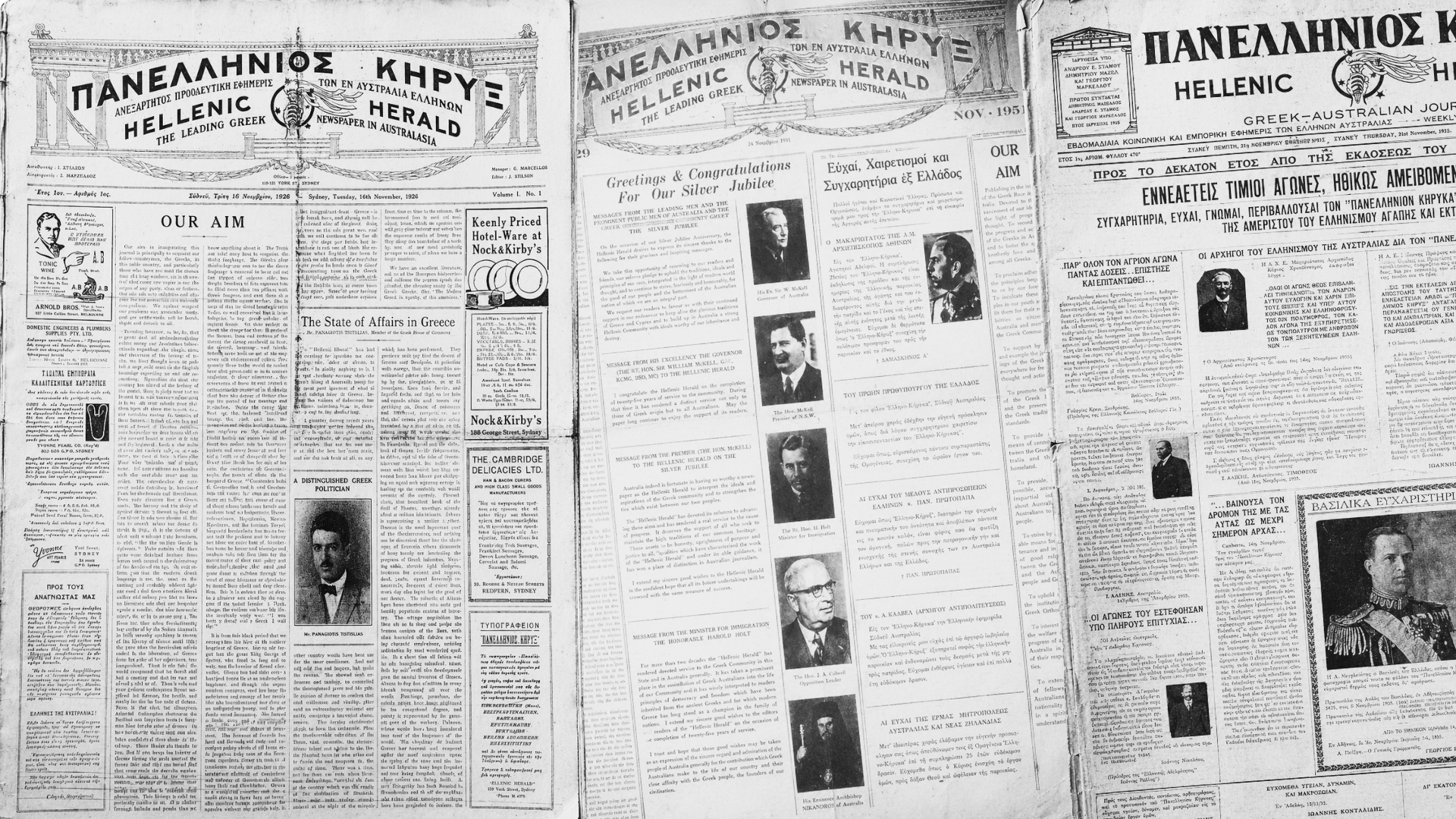
When the first edition of Panellinios Kiryx — the publication that would later become The Greek Herald — rolled off the presses in Sydney on 18 November 1926, few could have imagined that the newspaper would survive to become the longest continuously published Greek-language daily outside Greece.
Yet from its very inception, the newspaper was never merely a newspaper. It was an institution born in struggle. It was a battleground for ideology, faith, migration, language, politics, survival and identity. It emerged during one of the most formative and volatile periods in the history of Greek Australia — a time when the foundations of organised Hellenism in Australia were still fragile and uncertain.
Its first publisher and manager, George Marcellos, and its inaugural editor, John Stilson, laid the foundations for what would become one of the most important institutions in Greek Australian history. Marcellos, a Kytherian migrant and businessman, envisioned a modern Greek-language newspaper capable of connecting and informing Australia’s scattered Hellenic population. Stilson, meanwhile, gave the newspaper its earliest editorial personality through a forceful, highly political and often confrontational style that resonated strongly with working-class migrants.
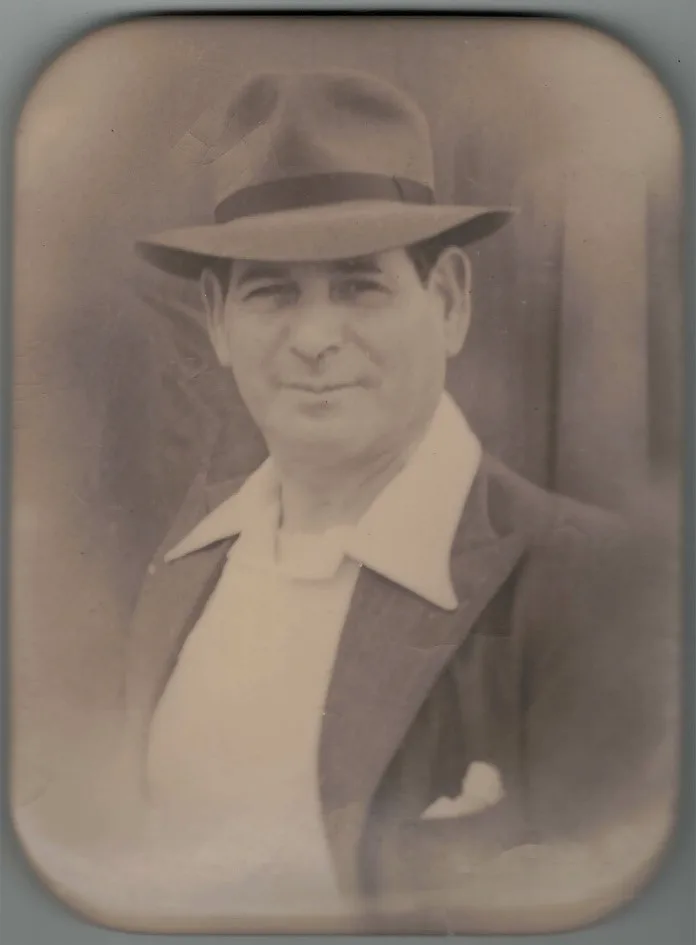
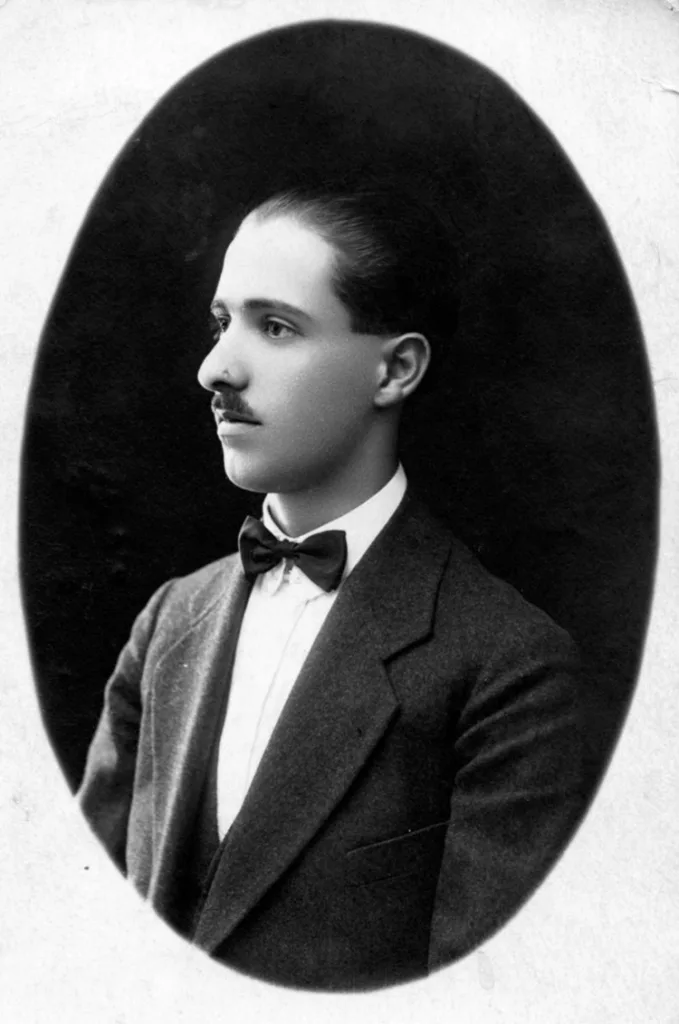
Alongside Marcellos and Stilson, Alexandros Grivas quickly emerged as one of the newspaper’s defining early figures. Initially serving in editorial and administrative roles, Grivas became deeply associated with the newspaper’s militant anti-Patriarchate stance during the schism years and later evolved into one of the most influential organisers and managers in the paper’s history. His presence would shape the newspaper for decades.
From modest beginnings printing manually in a basement on Oxford Street in Sydney, The Greek Herald quickly evolved into a powerful voice within diaspora life.
The first decade of The Greek Herald was defined by ecclesiastical schism, political polarisation, racism against migrants, economic depression and fierce debates over the preservation of Greek identity in Australia. Yet the newspaper also became a central institution for communal organisation and advocacy, documenting — and often directly shaping — the growth of schools, churches, welfare efforts, cultural organisations, sporting associations and political movements across Australia.
By the mid-1930s, the newspaper had become not merely an observer of Greek Australian history, but one of its principal architects.
A newspaper born into division
The newspaper entered a Greek Australian world already fractured by ideological conflict imported from Greece.
The aftershocks of the National Schism between Venizelists and Royalists had reached Australia long before the publication of The Greek Herald. Politics, religion and identity were deeply intertwined, and tensions within the Greek Orthodox communities reflected broader divisions in Greece itself.
Only two days after the inaugural issue appeared, the Greek Orthodox Community of New South Wales formally severed ties with the Ecumenical Patriarchate and aligned itself with the Autocephalous Greek Orthodox Church of America and Canada under the controversial and defrocked Metropolitan Vassilios Komvopoulos.
At the same time, the Liberal government of Eleftherios Venizelos appointed parliamentarian Panagiotis Tsitsilias to Australia to support the establishment and circulation of The Greek Herald as a liberal counterweight to the royalist newspaper Ethnikon Vema.
The Greek Herald quickly became one of the most vocal supporters of the anti-Patriarchate movement. Although the newspaper broadly aligned itself with the liberal politics of Venizelos, its editors fiercely opposed Metropolitan Christophoros Knitis and the authority of the Patriarchate in Australia.
The split soon became institutional as well as ideological. Supporters of Rev. Athenagoras Varaklas and the Greek Orthodox Community of NSW remained centred around St Trinity (Agia Triada), while Metropolitan Knitis, the Greek Consul and their supporters established the rival Agia Sophia community in Sydney in 1927.
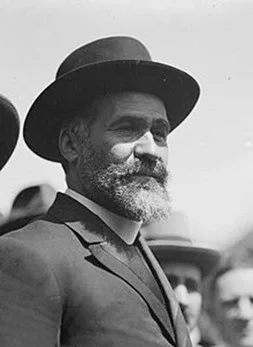
In those days, the paper adopted an aggressively populist tone, presenting itself as the defender of ordinary migrants — the “Xypolytoi” or “Barefooted Ones” — against what it portrayed as the domination of clergy, diplomats and wealthy communal elites.
Its editorials frequently attacked the Patriarchate, the Greek Consulate, Agia Sophia and rival newspaper Vema, while strongly defending Rev. Athenagoras Varaklas despite his defrocking. The rhetoric was often inflammatory and deeply divisive.
The consequences of the schism were profound. Sacraments performed by defrocked clergy were declared invalid by the Greek state, creating confusion and anguish throughout the diaspora. Marriages, baptisms and funerals became sources of bitter dispute between rival factions. In one heartbreaking case reported by the newspaper, a grieving father in Melbourne was refused funeral rites for his child because the boy had been baptised by a defrocked priest.
The dispute also generated legal battles, diplomatic conflict and intense hostility between rival camps. The paper repeatedly campaigned against Greek Consul Leonidas Chrysanthopoulos, publishing open letters demanding his removal and accusing him of supporting royalist and anti-community interests. In 1928, the Consul launched legal action against The Greek Herald and members of the Greek Orthodox Community of NSW over defamatory editorials.
Throughout these years, the newspaper was not merely reporting the schism — it was actively driving it.
Advocacy through education and language
Yet despite its combative style, The Greek Herald was also laying the foundations of organised Hellenism in Australia.
One of its earliest and most important campaigns focused on Greek language education.
In March 1927, Anna Perivolaris established a private Greek school in Sydney with support from the Kytherian community. Only weeks later, the Greek Orthodox Community of NSW founded its own Greek Community School and appointed Evanthia Vergou as its first qualified teacher from Greece.
The newspaper strongly promoted these initiatives and repeatedly argued that language preservation was essential to the survival of Hellenism in Australia.
Throughout the decade, the paper campaigned for the creation of schools not only in Sydney, but also in Melbourne and other centres. It regularly warned that without language, future generations would lose their connection to Greek identity, Orthodoxy and history.
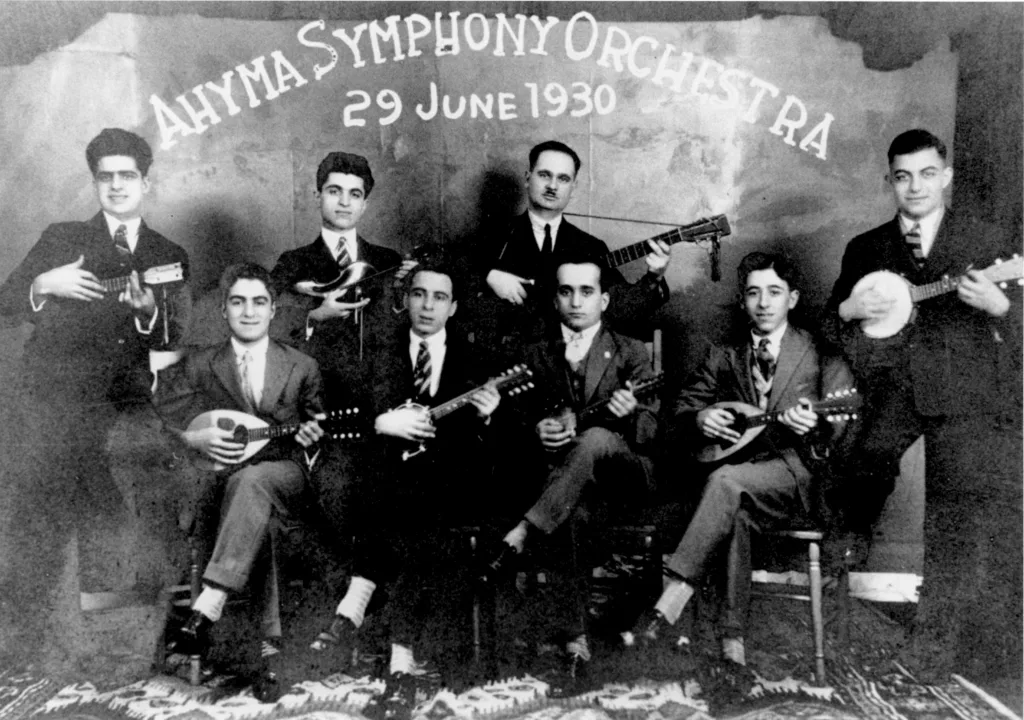
The newspaper also advocated for broader cultural development. It supported theatrical groups, musicians, libraries and literary activity, believing that Hellenism in Australia required intellectual and artistic foundations, not merely churches and businesses.
In August 1930, the newspaper celebrated the establishment of Sydney’s first Greek lending library, initiated by Alex Grivas. In 1931, it extensively covered the debut of Australia’s first Greek theatrical group at Sydney’s Savoy Theatre.
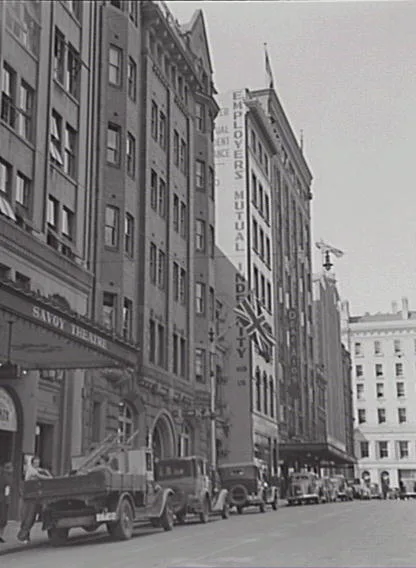
The paper also championed Greek scouting movements, youth associations and artistic societies, recognising that organised community life would determine whether Hellenism survived permanently in Australia.
Building a national Greek network
As the newspaper expanded, it increasingly became the connective tissue linking scattered Greek settlements throughout Australia.
Its pages documented Greek life in Sydney, Melbourne, Brisbane, Perth, Adelaide, Newcastle and regional towns. The paper reported on Greek cafés in remote Queensland, brotherhoods in Western Australia and church disputes in Victoria.
Marcellos personally undertook extensive tours through regional Australia from 1930 onwards, visiting hundreds of Greek settlements across New South Wales and Queensland. These journeys were more than promotional exercises. They represented an attempt to create a national consciousness among geographically isolated migrants.
At a time when many Greeks lived in rural towns with little contact with other Hellenes, The Greek Herald became their primary connection to the wider diaspora.
The newspaper’s advocacy extended into communal organisation itself. It documented and encouraged the creation of community associations, women’s organisations, trade unions and regional brotherhoods.
It supported the formation of the Greek Community of Adelaide in 1930 and extensively covered organisational developments within communities across the country.
The paper recognised that organisation — not merely survival — was the future of Hellenism in Australia.
A voice against racism
One of the newspaper’s most important roles during its first decade was its persistent confrontation of anti-Greek racism. Throughout the late 1920s, Greeks were frequently portrayed in the Australian mainstream press as dirty, dishonest, diseased and unassimilable. Politicians and judges openly used racial slurs.
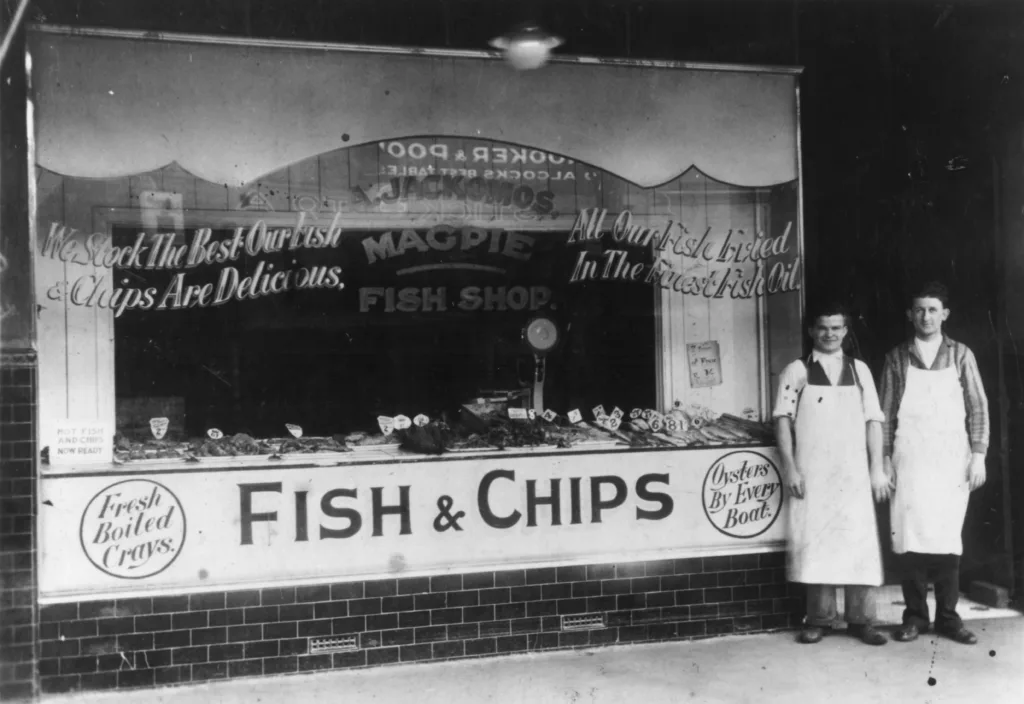
A Western Australian premier referred dismissively to Greeks as the “Fish and Chips Crowd,” while an Adelaide judge infamously suggested that knife violence might be expected from Greeks but not from “British people.”
Mainstream newspapers repeatedly published anti-Greek campaigns accusing Greek cafés and fruit shops of threatening public health. One especially vicious Brisbane campaign in 1928 warned Australians not to buy from Greek shops and depicted Greeks as racially inferior outsiders contaminating White Australia.
The Greek Herald became one of the few public voices directly confronting such xenophobia. It accused Australian newspapers of vilifying migrants and criticised Greek diplomatic authorities for failing to adequately defend the community.
The paper also documented the humiliations experienced daily by migrants. One report recounted how a child entered a fruit shop and addressed the owner as “Mister Dago.”
Yet the newspaper’s advocacy was not simplistic. It also warned Greek migrants that poor hygiene, exploitative business practices and gambling culture in some cafés damaged the broader community’s reputation.
Its editorials therefore combined defence against racism with calls for communal self-improvement.
The Great Depression and welfare advocacy
The onset of the Great Depression transformed the newspaper’s editorial priorities.
Beginning in 1928 and intensifying after 1929, The Greek Herald devoted enormous attention to unemployment, homelessness and economic collapse among migrants.
The paper documented unemployed Greeks wandering city streets, cafés collapsing into bankruptcy and migrants unable to support families left behind in Greece. One especially tragic report detailed the suicide of unemployed migrant Christos Sofertis in Melbourne’s Yarra River after economic hardship overwhelmed him.
The newspaper became one of the strongest advocates for struggling migrants during the Depression years. It repeatedly exposed exploitative migration agents in Greece and Egypt who falsely promoted Australia as a land of prosperity despite mounting unemployment.
At the same time, the paper campaigned for welfare and solidarity within the Greek community itself.
Greek cafés and kafeneia became informal welfare centres where unemployed migrants received food, shelter and companionship. The paper celebrated owners who fed compatriots without payment and transformed their cafés into spaces of mutual aid.
The newspaper also publicised charitable appeals following natural disasters and humanitarian crises.
After the devastating Corinth earthquake of 1928, The Greek Herald launched fundraising campaigns across Australia for victims.
In 1931, the paper extensively covered fundraising efforts by Cypriot Australians for families affected by the anti-colonial uprising in Cyprus.
Philanthropy and communal obligation became central themes within the newspaper’s worldview.
The arrival of M.E. Malachias
A decisive turning point came in 1929 with the arrival of journalist and intellectual Michael Emmanuel Malachias, known by the initials “M.E.M.” Replacing Stilson as chief editor, Malachias fundamentally reshaped the tone and direction of the newspaper.
Under his leadership, The Greek Herald moved away from crude polemics and embraced a more educational, analytical and reconciliatory editorial philosophy. The language of the newspaper became simpler and more demotic.
Malachias broadened the paper’s scope dramatically. It increasingly focused on Australian politics, economics, migration, labour conditions, education and the long-term future of Hellenism in Australia.
Under his stewardship, The Greek Herald became intellectually ambitious and encyclopaedic. By 1929, it regularly published articles on international affairs, Greek culture, diaspora identity and Australian politics.
Malachias also wrote important reflections on migration history, arguing that many early Greek settlers had arrived “accidentally” as sailors, labourers and ship jumpers.
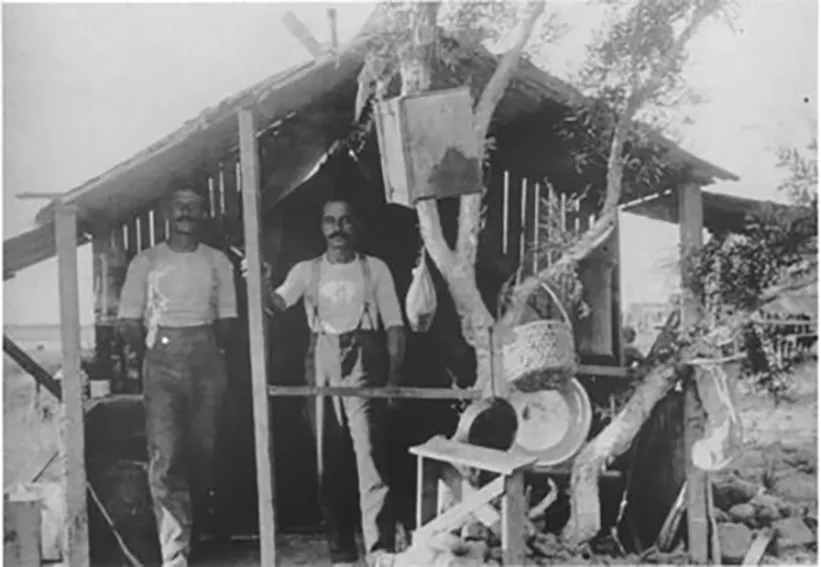
He believed that disunity and internal antagonism had slowed the development of organised Hellenism in Australia. Most importantly, he attempted to steer both the newspaper and the wider community toward reconciliation.
Hellenism, nationalism and identity
Throughout the early 1930s, The Greek Herald increasingly positioned itself as the guardian of Hellenic identity in Australia.
The paper campaigned relentlessly for the preservation of Greek language, culture and Orthodoxy. It warned parents that assimilation threatened the future of Hellenism in Australia.
The newspaper also remained deeply engaged with Greek national issues abroad.
Its pages covered Macedonia, Cyprus, Asia Minor Hellenism, the Dodecanese question, Northern Epirus and the preservation of Greek communities in Constantinople, Imvros and Tenedos. The paper strongly opposed the Italicisation of Kastellorizians under Italian rule and consistently defended Greek national consciousness abroad.
The 1931 anti-colonial uprising in Cyprus received particularly extensive coverage. The paper cautiously sympathised with the revolt while avoiding language that might attract Australian security scrutiny.
The newspaper also became deeply involved in debates over assimilation and citizenship.
In 1931, The Greek Herald argued that Greeks in Australia should obey Australian laws but never surrender their national conscience. It condemned naturalisation as a betrayal of Hellenism and denounced those who became British subjects as “traitors.” This position sharply contrasted with rival newspaper Vema, which advocated integration into Australian society.
The debate reflected a community still uncertain whether Australia represented a temporary refuge or a permanent homeland.
Reconciliation and survival
By the early 1930s, the bitter ecclesiastical schism that had dominated the newspaper’s early years gradually began easing. The enthronement of Archbishop Athenagoras in America and Metropolitan Timotheos in Australia created the conditions for reconciliation.
In 1931, the Sydney Greek community accepted the authority of the Patriarchate once more and moved toward reunification.
The newspaper, which had once fuelled the conflict so aggressively, increasingly supported peace and communal unity.
The early 1930s also brought an important ownership transition. In 1933, control of the newspaper passed to Demetrios Lalas, a businessman who had accumulated wealth through commercial ventures in China. His stewardship helped stabilise the paper financially during the difficult Depression years and ensured its survival through one of the most uncertain periods in its history.
The early 1930s also brought an important ownership and managerial transition. In March 1933, control of the newspaper passed from George Marcellos to businessman Demetrios Lalas, who had accumulated considerable wealth through commercial ventures in China. Yet the restructuring also elevated Grivas into one of the paper’s central leadership roles. Grivas assumed managerial and administrative control of the newspaper and would remain one of the dominant figures in its operation for decades thereafter.
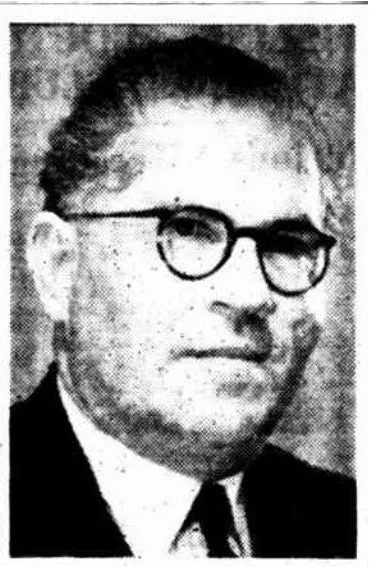
The Lalas–Grivas–Malachias period marked a new phase in the newspaper’s evolution: financially more stable, editorially more sophisticated and increasingly committed to building permanent communal institutions rather than merely fighting ideological wars.
The newspaper that helped build Greek Australia
By the close of its first decade, The Greek Herald had evolved dramatically from the combative publication first launched in 1926.
It had survived ideological warfare, ecclesiastical schism, legal battles, racism, economic depression, migration restrictions and communal fragmentation. At the same time, it had helped nurture the emergence of organised Greek life in Australia.
Its pages recorded the establishment of schools, women’s organisations, sporting associations, theatres, libraries, trade unions, youth movements, regional brotherhoods and community institutions throughout the country.
It advocated for migrants during economic hardship, defended Greeks against racism, campaigned for Greek language education, mobilised philanthropy during natural disasters and humanitarian crises, promoted culture and theatre, and remained fiercely committed to the preservation of Hellenism abroad and in Australia.
Most importantly, it became the principal historical archive of the Greek migrant experience during one of the most fragile and formative periods in Australian Hellenism.
The first decade of The Greek Herald was messy, passionate, divisive and deeply human. It reflected the anxieties of migrants trying to build a future while holding tightly to their past.
In doing so, the newspaper laid the foundations not only for its own survival, but for the survival of organised Hellenism in Australia itself.
